Showing posts with label film. Show all posts

Yiddish Film: Menashe (2017)


There are a lot of posts I do where I feel like am a duplicating the efforts of other. As an example, there is a fairly comprehensive book on Yiddish film, "Bridge of Light" by Village Voice film critic J. Hoberman. There is probably some value in me writing about, say, "Mamele," in that criticism always benefits from a plurality of voices, but aside from my own eccentric take on the subject I don't think I can contribute any new information not provided by Dr. Hoberman.

But Hoberman wrote his book in 1995, so there has been 22 years of new Yiddish film since then, and they have not been written about comprehensively. And every so often I get to tackle a new film relatively early, such as "Menashe," an independent film I viewed at the Minneapolis St. Paul Film Festival; it has not yet gone into wide release.

In some ways, I feel like I got into this one too early. The film is set in a Hasidic community in Brooklyn, and is largely made up of Hasidic and ex-Hasidic actors. It was scripted by director Joshua Z. Weinstein, along with Alex Lipschultz and Musa Syeed, none of whom, to the best of my knowledge, have extensive experience with the Haredi experience (in fact, Syeed is Muslim.)

But director Weinstein has a background in documentary filmmaking, and it sounds as though the cast (especially including star Menashe Lustig, whose biography this movie borrows from) contributed to the eventual film. Presumably this brought a needed authenticity to the story, with the cast and star acting as a refernce and providing checks and balances to how they are represented. But, again, the film is not yet in wide release, and probably will not generally be seen by Hasids, who tend to avoid secular films. I have some connections in the ex-Hasid world, and will be curious to see what they think.

From the outside, the film seems unusually nuanced. Firstly, the plot: The movie tells of a widowed Hasidic man and his troubled relationship with him community and his son. Menashe, played by Lustig, is an eccentric by Hasidic standards, particularly in his refusal to remarry. He seems to be wavering between extremism and liberalism, but mostly seems to be struggling both with poverty and immaturity.

Menashe is a shlemiel -- he's called that by his brother-in-law. Usually this word suggests someone who is comically unlucky or inept, but "Menashe" is not a comedy, and so the main character's experiences are more often frustrating or humiliating than humorous. Especially thorny: His son has been taken away from him until he remarries.

At first, this seems like an unusually cruel communal convention. Menashe deeply loves his son, and it visibly tortures him to be separated. (It should be noted that Lustig's performance in this film is superlative; the whole cast is superb.) But the film also hints that this rule is specifically being enforced because Menashe is too immature to properly care for his child; he can't even properly tend for a pet chicken he has purchased.

It can be tough to watch. There is a line in the movie "Amelie" that describes a character as not liking to see a parent humiliated in front of their child, and sometimes this seems to be the entirety of "Menashe." Additionally, the title character reveals the source of his ambivalence about marriage, and it becomes obvious that he's deep in the throes of what is called "survivor guilt." His guilt about his wife's death, and his relationship beforehand, may be the source of his irresponsibility and occasional hostility toward his community, which has neither the skills nor the language to address his experience.

The film allows both flashes of compassion and cruelty -- the same community leader that slips Menashe extra money and praises his terrible cooking is, in another scene, shown refusing a girl the opportunity to go to college. We just hear her in the background, and hear that her heart is broken.

The film represents the extent to which Hasidic life is circumscribed by ritual -- we see Menashe praying at night before he goes to sleep and washing his hands as soon as his wakes. It's a balancing act, as, if the film approached the subject as a documentary might, it would be possible to get lost in the rituals -- the thrice-daily prayers; the complicated rules around what can and cannot be done on shabbos; the dense, insular language of piety. The Hasidic world in not merely closed because some speak Yiddish, or because some live in religious enclaves, or because it has a handful of particular rules.

No, it is a denser world than that, and the film carefully threads the needle as to showing the particulars of that world while opening it up enough for viewers to connect with Menashe, his grief, and his struggles to reconnect with his son. As an outsider, I feel the filmmakers did a fine job with this, but, as I said, I do not yet know what insiders (or, at least, former insiders) think.

Guillermo del Toro at MIA


Film director Guillermo del Toro has an exhibition at the Minneapolis Institute of Arts just now titled At Home with Monsters. It's the second stop for this show, which originated at the Los Angeles County Museum of Art, although, really, it originated with a Los Angeles house del Toro owns that he calls Bleak House, after the book by Dickens.

Del Toro is a consummate collector. "If you give a Mexican three objects, he will make a shrine," he told a crowd at MIA on opening day, and he prides himself on reflecting the shrine-like ulrabaroque sensibilities of Mexican artists. Del Toro has collected since he was a boy, mostly work related to the supernatural and especially related to the supernatural in film, and his collection has grown so large that it has its own house. Bleak House.

I attended the exhibit on opening day, listened to a talk del Toro gave, got him to sign a book, and then, just by a stroke of luck, found myself part of a private tour of the exhibit led by del Toro. He was uncommonly generous, spending an hour and a half, almost two hours explaining his collection. There were original designs for Disney films, original cartoons by Richard Corben and Gahan Wilson, uncannily realistic sculptures of H.P. Lovecraft and Edgar Allen Poe, and original costumes and props from del Toro's films. He had stories about all of them, and could minutely detail the process by which the art was made, and offer biographies of the artist.

Del Toro is, himself, a filmmaker of indulgent detail. Superficially, many of his film seem to be pop confections, enjoyable but slight cartoon glosses on established horror tropes. (I am referring to films like the Hellboy movies and "Pacific Rim" here; his "The Devil's Backbone" and "Pan's Labyrinth" are undisputed masterpieces.)

But even those film are crammed with significant details, and, on each viewing, the films grow deeper as his talent for visual storytelling comes to the fore. Characters who appear for only a moment grow in significance when we notice these details, like the Russians in "Pacific Rim" who pilot a giant robot, and who are literally welded into its stomach; they have no possibility of escape, so every battle is to the death. They are onscreen for perhaps two or three minutes, but have become fan favorites due to the amount of information it is possible to glean in that time.

Del Toro is a pop filmmaker, and yet he is one that his fans feel a private relationship with, thanks to these details. It is as though his films are full of secrets, available for those who care enough to dig, and eventually you find a secret intended specifically for you.

Examples: Disabled audiences noticed that the two scientists in "Pacific Rim" have  disabilities, and how, despite their rancorous relationship, they demanded respect for the other's disability; The class conscious noticed that Idris Elba played his role with his native, working-class Hackney accent; Feminist audiences noticed that Rinko Kikuchi's character was secretly the star of the film, and Japanese audience noticed that her most significant moment was presented in untranslated Japanese.

So here's the secret that is speaking to me just now, and it isn't such a big secret, but it seems especially meaningful to me just now, and it's the reason why I feel this discussion belongs on a Jewish blog. Del Toro is one of the few filmmakers working today who shares a certain sensibility with the horror films of the 30s and 40s, and that sensibility is as follows:

Fascism is a terrible thing and it must be resisted.

I'll start with the old movies. Horror developed as a genre at the exact moment fascism rose in Europe, and often seemed to reflect on the fact, detailed in the book "From Caligari to Hitler: A Psychological History of the German Film" by Siegfried Kracauer.

It was there in hints in the early films, including "Dracula," which used the same sorts of motifs of blood-sucking vermin that the Nazis favored, but made the villain European royalty, rather than Jews. There was "The Invisible Man," in which a lunatic plotted to rule the world through a campaign of terror. As more of these films were made, they became a shore upon which dozens, and eventually hundreds, or European filmmakers washed up, seeking refuge from European fascism.

As this happened, the themes became more visible and obvious, including "The Wolf Man," in which a poisonous savagery spreads through Europe (marked by a star on the body); and "The Black Cat," in which Bela Legosi arrives to take a terrible revenge on a war criminal, played by Boris Karloff.

Del Toro has unambiguously addressed fascism, setting two of his films, "The Devil's Backbone" and "Pan's Labyrinth," during the Spanish Civil War. "Hellboy" is set in the shadow of the Holocaust, with the occultist German Thule Society (a predecessor to the Nazi Party) rising up to bring about genocide. Even "Blade 2" based itself around a disastrous eugenic experiment designed to breed a master race.

Del Toro speaks often about fascism, and how, in his films, the monsters are rarely the villains, but, instead, it is humans who are often the most monstrous. "What interests me about fascism is that it is a black hole of free will," he has said. "It is a system which isn’t necessarily unique, but it absolves brutality, it absolves the lack of morals and it absolves people of their own decisions. When they tell you ‘you can kill these people because they are Jews, reds or homosexuals, or whatever!’ In this world you can permit a brutal action on the base of collective advice; that is what scares me."

He understands the appeal of fascism: "One of the dangers of fascism and one of the dangers of true evil in our world—which I believe exists—is that it's very attractive. That it is incredibly attractive in a way that most people negate. Most people make their villains ugly and nasty and I think, no, fascism has a whole concept of design, and a whole concept of uniforms and set design that made it attractive to the weak-willed"

He is open about the fact that he uses horror as a metaphor for addressing fascism, saying "What I really set out to do with 'Pan’s Labyrinth' was to make an anti-fascist fairytale — which I think is very pertinent to our times right now! I really like exploring big, political events through metaphors, and I think horror is a very political genre."

And what interests me about del Toro's film is not merely that their look into fascism, but also the way they prioritize resistance to fascism. The woods in "Pan's Labyrinth" is filled with guerillas, taking up arms against Spanish fascists, while a quieter revolution goes on inside the house of one of the fascist leaders. In it, his housekeeper is secretly a revolutionary, while his daughter slips into a metaphoric realm in which she is constantly confronted by appealing demands to do evil.

This feels like a time when we need movies that recognize fascism as a breeding ground for monsters, and celebrate resistance to it, even if that resistance is imprecise, or metaphoric, or suicidal. Because del Toro's films also show us what the world looks like after fascism: A wasted place of mass death and abandoned weapons that still might become deadly at any moment.

This world. Our world.

It has real monsters in it, and someone really does need to stand up to them.

Jewish Christmas Movies: Elf (2003)


There's a trick you can play with almost any Christmas movies, where you dig into it and you find Jews. Take "It's a Wonderful Life," which was mostly written by Frances Goodrich and Albert Hackett, who weren't Jewish (but did author the stage and screen version of "The Diary of Anne Frank.") But the film underwent extensive rewrites, and those uncredited writers included Jo Swerling and Dorothy Parker, who were Jewish. Additionally, the film's score was by Jewish composer Dimitri Tiomkin.

Now, "It's a Wonderful Life" is not an especially Jewish film, and points to the problem with simply identifying Jews who participated in the filmmaking. I'd like to believe anything a Jew worked on becomes somehow Jewish as a result, that the rich vein of pathos that runs through "It's a Wonderful Life" is the product of a Jewish sensibility, but I can't.

So when I list Jewish involvement in the 2003 comedy "Elf," I do so knowing it proves nothing. But I want to start with a list, just to make it clear that "Elf" wasn't a film that merely had Jews involved in its making. It was a film made by Jews.

Firstly, the script, about a boy raised in the North Pole who returns to New York to find his biological family, is by David Berenbaum, a Jewish writer from Philadelphia. The film was directed by Jon Favreau, who is the product of a mixed marriage and was raised Jewish. The film features Jewish actors James Caan and Daniel Tay as father and brother of the film's title character. (I presume Tay is Jewish -- some web sleuthing suggests he grew up to attend Yale, was vice president of the Alpha Epsilon Pi Jewish fraternity, and studied Jewish/Judaic Studies at the Pardes Institute of Jewish Studies, which seems pretty Jewish.) Beyond that, the film is populated with Jewish actors, including Ed Asner as Santa Claus, Michael Lerner as a book publisher, and Favreau himself as a pediatrician.

On the surface, this is a film that lovingly borrows from previous Christmas movies, with explicit references to Rankin-Bass cartoons, "Miracle on 34th Street," and "A Christmas Story." (It includes a cameo from Peter Billingsley, who played Ralphie in "Christmas Story.") It's a reach to find explicit Jewish content, but for a lone menorah tucked into the back of the pediatrician's office.

Still, it's hard not to get the sense that some autobiographical material slipped in. Favreau often discusses being the product of intermarriage in interviews, and he did extensive rewrites on the script for "Elf."

There are a bunch of intangible elements, but collectively they contribute to a feeling, at least for me, that the family at the center of this movie is intermarried. Obviously, there is Caan and Tay as father and son. Cann is playing against his usual gruffness in the film, replacing the hotheadeness of the characters he played in his youth with a furrowed, bewildered discomfort. He's never seemed more Jewish in a film.

Caan never seems especially invested in Christmas, and almost literally crawls with mortification when Will Ferrell's Buddy shows up. It's a recurring joke in the film that Buddy's love for Christmas is a little too much for anyone to take, but Caan has the weariness of someone who compromised on a little Christmas, but wasn't prepared to go all in on the holiday. He barely complains when his boss forces him to work on Christmas Eve, and the film never bothers to include a scene in which he much explain the fact to his family. It's just a family where the father might be absent on Christmas and nobody makes much of a fuss about it.

Compare this to a similar scene in the Will Ferrell comedy "Step Brothers," in which Will Ferrell's stepfather, played by Richard Jenkins, gets up and leaves a Christmas party. His absence is treated as the climactic moment of a familial breakdown, and his marriage almost immediately unravels. For most people, Christmas is important, and missing Christmas in meaningful.

Tay goes to confront his Caan on Christmas Eve, but it isn't because he is at work on Christmas, rather because Buddy the Elf has run off, and he doesn't grow upset with Caan until it seems like the older actor might not even leave his business meeting for that.

This feels strange. It's a scene created by people who don't invest the sort of weight into Christmas that most Americans, and most American Christmas movies, do. This is likely because it was made by Jews, and the lack of weight they give to Caan skipping Christmas might be an unconscious product of that. But it accidentally ends up making it feel like Caan and his son are Jews, and Christmas is mostly of an enjoyable curiosity for them.

Even when they meet Santa, they seem happily bemused rather than thrilled. Tasked with helping him, Caan seems unimpressed, and must be cajoled into singing Christmas carols despite the fact that this is the very thing that will help Father Christmas.

I know I am reading into the film, finding meaning as much in stuff that was left out as in stuff that was put in. But coming from a Jewish family, growing up with friends who were the product of intermarriage, knowing old Jewish men like Caan (including Caan, who I have met on a number of occasions), and being a Jew who participates in Christmas each year due to my long relationship with a non-Jewish woman, I can't help but recognize something in Caan's performance.

I can't help but see a Jewish man who gamely is going along with a holiday that is not his, but doesn't have the depth of familial and cultural experiences to make it as meaningful for him as it is for the people he loves. I don't know how much of this performance was the result of Caan or was influenced by the writing or direction, but it sharpens the story a little.

Because if Buddy's fanaticism about Christmas is a little hard for everybody to take, how much harder for a Jewish biological father? It's tough. You can see it in Caan's eyes. A little Christmas, okay. But this?

Jewish Fantasy Films: Fantastic Beasts and Where to Find Them (2016)

Edna

I am tempted to re-title this film "Fantastic Jews and Where to Find Them," as three of the film's four main characters are Jewish. Well, ostensibly Jewish -- they don't explicitly reference Judaism, neither do they participate in Jewish religious life in any way. But there are sisters Tina and Queenie Goldstein and aspiring baker Jacob Kowalski and they inhabit New York's Lower East Side in the 1920s, so if they are not Jewish, they are confusing everyone they meet.

(Most tellingly, there is some indication the film is set at Christmas, including Christmas decorations, which none of the main characters seem to have any interest in. The characters even visit Macy's and do no Christmas shopping whatsoever, which seems like a violation of a very basic rule of seasonal filmmaking.)

There are Jews in the cast as well: Kowalski is played by Dan Fogler, and the cast is rounded out by Ezra Miller as a religious boy in a haircut that seems lifted from "The Golem," Ron Perlman as a speakeasy owner who also happens to be a goblin, and Zoë Kravitz as a girl in a photograph -- presumably she will be more important in later chapters.

Screenwriter J.K. Rowling has been vague about her characters' ethnicity -- she generally is, and when she isn't, as when she wrote about Native Americans in her "History of Magic in North America," she can be more than a little tone deaf. So perhaps it is best that she did little more than give characters Jewish names and plop them in a Jewish setting. We can write our own fan fiction about Jacob Kowalski's nights at the Yiddish theater or Queenie Goldstein encountering Illinois' Flapper Ghost in the Jewish Waldheim Cemetery.

But it does not feel unmeaningful that these characters are Jewish. Rowling has said that she was partially inspired by the rise of European populism, and so here we are, watching a film set in the years just following Hitler's release from prison and re-founding of the Nazi Party, in the era of the rebirth of the KKK in the United States.

It's tempting to try to make all of this film's witches and wizards into surrogate Jews. After all, it seems like every single wizard and witch in New York works for a Judenrat-style ministry, designed to enforce rules that push for invisibility and assimilation -- without this, the film's wizards fear genocide at the hands of humans.  There is a character in this film who has been suppressing their magical ability, adopted by a fundamentalist who seeks to exterminate witches. This character has been driven mad by doing so, becoming literally homicidal, which is about as forceful an argument against assimilation as I have ever seen onscreen.

But Rowling's story offers an inexact parallel. This story is a prequel, of sorts, to the Harry Potter films, and follows the rise of a character named Gellert Grindelwald, who appeared briefly in the world of Harry Potter but had a rather complicated backstory. Here played by Johnny Depp, Gellert Grindelwald is to lead a revolution in which wizards reject their secrecy in favor of creating a dictatorship in which magic users have power over non-magic users.

It's been broadly hinted that this storyline will be the one to parallel the rise of European populism, and so Rowling has set her movie's fascism, not among the fearful and murderous masses of humanity, but rather among a despised and hunted minority. This complicates the story considerably, as were this an exact parallel to historic Nazism, it would be like telling a story where the Nazis rose out of the Jewish community, or where it an exact parallel to modern populism, it would be wound in which an anti-immigrant ultra-nationalist movement rose out of Europe's Muslim population.

So the metaphor breaks down fairly quickly. But Rowling's stories have always been about a parallel world of magic that rarely touches the one we inhabit, and so it makes sense that her parallel fascism should play out in that world, rather than ours. Especially as it is abundantly obvious that if there were to be a war between humans and wizards, it is likely that it is humans who would experience genocide at the hands of wizards, and not vice versa. These characters are just too powerful to be credible victims to humans -- in this film, one angry child very nearly levels a city.

Setting this story in the world of magic also allows Rowling to do something she does very well, which is create a sort of fantastical diorama, free of complicated historical phenomenon, in which she can create essentially a shadow puppet show for the world's ills. In the Harry Potter books, she set most of a titanic struggle for world control at a remote boarding school, which gave a sprawling story unusual clarity and focus.

Here she is playing with a larger canvas -- instead of setting her tale at Hogwarts, here it is set in the entirety of 1920s New York. But she still focuses the story on a small group of heroes, led here by Eddie Redmayne as a sort of magical naturalist. (Redmayne provides a performance that is both unforced and extraordinarily eccentric, and carries a briefcase improbably stuffed with the film's titular fantastic beasts.) And by setting it in the world of magic, she can avoid the messy historical details that lead to totalitarianism, including nationalism, state controlled corporations, and despised migrant populations, and instead focus on a less messy magical version: Wizards are powerful and unfairly despised, therefore wizards should be in charge.

It remains to be seen what it means to simplify fascism like this for the sake of storytelling, or what it will be like including Jewish characters in such a story. I just don't know. Rowling has a canny way of slipping little details into her stories that re-complicate them, and sometimes complicated stories benefit from this sort of abstraction. Fascism is not a simple subject, and it is easy to get overwhelmed by the complications.

I will take one moment to explore one small detail of the film, and how it deepens the storytelling. I don't think it is accidental that Rowling named her flapper character Queenie, but I can think of only two possible previous examples. Both are interesting.

The first is an obvious one, for anyone familiar with the history of American musicals: Queenie, the cook on the Cotton Blossom show boar in the musical "Show Boat." She is a black character, but the original book was authored by a Jew, Edna Ferber, and adapted into a musical by a Jew, Jerome Kern, as well as by Oscar Hammerstein II, who had a Jewish father. The musical explicitly deals with the problems of enforced segregation.

The second example is a stranger one: Queenie is the flapper protagonist of Joseph Moncure March's jazz age poem "The Wild Party," which is mostly a profile of artistic decadence. Although Queenie herself is not Jewish in the poem, a variety of the characters who surround her is -- some caricatured to the extent that March rewrote sections for a later release, finding them to be antisemitic. One of the stage adaptations of this poem expands on one of these characters, Gold, a theatrical producer, desperate to change the name of his partner, Goldberg, to something less obviously Jewish: Golden.

So just by exploring a character's name, we find rich associations, including segregation, antisemitism, and assimilation, all themes in "Fantastic Beasts." Like Redmayne's briefcase, the film proves to be overstuffed; it may take a long time to unpack.

Jewish Horror Films: An American Werewolf in London (1981)


I had planned to write about the way Jewish filmmakers sometimes code their characters as being Jewish, sometimes in subterranean ways. However, upon a recent rewatching John Landis' "An American Werewolf in London," I realized there's nothing coded, nothing subterranean.

No, Landis' two doomed American leads are unambiguosly Jewish. They hail from Long Island, lust over a young woman named Debbie Klein, and get upset when she beds a fellow named Rudy Levine. A nurse peeks under the sheets when one of the boys is hospitalized and declares him Jewish. They call each other putz and schmuck. And, most tellingly, when one of the boys has a nightmare, it is of werewolves breaking into his family home dressed as Nazis and massacring everyone with machine guns, which also destroys a prominently placed menorah.

I suppose I might have been a bit confused because Landis cast two Irish-Americans as the boys -- specifically David Naughton and Griffin Dunne. But, even then, Naughton has a certain swarthiness and Dunne is neurotic in a strangely cheerful, comic way that reads as Jewish. And who am I to complain that Irish Americans are playing Jews? Every single one of my biological ancestors came from Ireland, and I am a Jew.

So instead I will instead discuss the way the characters' Jewishness informs the film. The plot is brutally easy to summarize: Two American boys on a three-month tour of Europe are attacked by a werewolf on the moors of Northern England, and one is killed. The other awakens in a London hospital, falls in love with a nurse (the terrific Jenny Agutter), and received repeated and unwelcome visits from his dead friend informing him that when the moon is full, he will become a wolf and kill innocent people. And, on the full moon, that's exactly what happens.

I suppose one the the reasons the Jewishness of the film had seemed subtle to me is because the film feels so very English. Landis is not English, of course -- he was born in Chicago and raised in Los Angeles. But he lived in London for a while, both working in film (sometimes as a stunt double) and cowriting, without credit, the James Bond film "The Spy Who Loved Me." Landis has also demonstrated a taste for Hammer horror films in later interviews and writing, and so "An American Werewolf" is heavy on English atmosphere.

In fact, the film opens with a series of long, static shots of the moors, demonstrating a fascination with the strangeness of the English countryside that I have only seen elsewhere in folk horror movies; it would hardly be surprising if he moved his camera and revealed people dancing naked around an enormous megalith while a figure burns in a wicker statue. Instead, when the camera moves, it is to reveal our heroes, crushed into the back of a truck filled with sheep. It's a comic image, but a smart one, because it immediately shows them misplaced and ill-at-ease, but also because they are about to be lambs to the slaughter.

In fact, the next place they end up is a rural pub called The Slaughtered Lamb, with an appropriately gruesome bar sign. The bar is filled with English character actors, as is the whole film. There's the battered visage of screen heavy David Schofield, the brutal looking ex-wrestler Brian Glover, the Cockney crime film star Alan Ford, and even the dazzling (and badly missed) comic actor Rik Mayall in a small role. The casting is perfect throughout the film.

There are a few reviews of the film that claim that we shouldn't be looking for subtly in a John Landis film, but this is a tremendously precise piece of filmmaking, from making sure Northerners speak with Northern accents to the fact that it is set in a London that is an international city, especially filled with Indian and Pakistani neighbors -- it was the only film I saw that captured a London that looked like that until the films of Hanif Kureishi some years later. Landis created a film that was supposed to be set in a London that felt like a real London, including a tour of the nurse's tiny apartment and complaints about the cost of living, which American films don't bother with.

That being said, Landis is also a satirist, and the film doesn't simply place London on the screen, but heightens it slightly. Little children will always be dressed in Paddington Bear style duffle coats or schoolboy uniforms with cricket hats. Businessmen will always have their brollies with them, even when fleeing monsters. The police are either gruffly or genially incompetent, especially the bobbies, who all have 'ello 'ello wots all this then accents and seem puzzled and put out by any request for help. Northerners all wear wellies and flat caps, are unwelcoming to visitors, and all have occult secrets. Even when we see a few moments of The Muppet Show, it is of Miss Piggy and Kermit watching a brutal English Punch and Judy show and arguing about its merits. There is a lot in the film that is genuinely daffy, and so these details don't spring out immediately, but they provide the whole film with a sense that Englishness is being slightly lampooned.

Our surviving American, Laughton, is contrasted with all this, in a variety of images that show him being wildly out of place. He finds himself surrounded by English punk rockers on public transit (and is caught when he briefly mocks them), he finds himself locked out of an apartment with children laughing at him, and, in ones of the film's longest sequences, he wakes up naked in the zoo and must nakedly navigate his way back to the apartment.

In fact, Naughton spends about 40 percent of the film naked, and I don't think it is unmeaningful that we hear about his circumcised penis early in the film, as he will spend a lot of the rest of the movie accidentally showing it to English people. He's not just an outsider because he is American, or because he is naked, but especially because he cannot avoid demonstrating that he's Jewish. It's subtext, I know, but I feel like his Jewishness adds a sharpness to his foreignness. Even the film's Pakistanis and Indians feel somehow like they are part of the necessary texture of London -- they are immigrants, but immigrants from British colonies with a long history of expatriating to England. For how out of place he seems, Naughton might as well be a space alien, or, I guess, a werewolf.

There was a sequel to this called "An American Werewolf in Paris," which I shan't bother with, but I will mentioned that I was terribly disappointed that we didn't revisit London, because there is more to explore of the tension between Jewishness and Englishness. There is, after all, a very long history of Jews in England, and a lot of what we think of as typically English were either introduced by Jews (eg. fish and chips) or came out of markets that Jews dominated (eg. English fashion). I suppose it is a bit much to ask for a film in which a Jewish werewolf interacts with the Jewish population of London, but I would see that film.

And this is a deeper cut, but it is possible to read the werewolf story as already being a subtly Jewish one as well. In this film, Naughton references an earlier werewolf film, and it's not the Oliver Reed version made by Hammer. It's the older one, the Lon Chaney one. He's talking about 1941's "The Wolf Man."

This was a film written by Curt Siodmak, a Jewish author from Germany who fled his native country after hearing an antisemitic speech by Nazi propaganda minister Joseph Goebbels. Now, Siodmak wrote a lot of horror films, and I'm not going to go digging through, say 1957's "Love Slaves of the Amazons" to look for Judaic content. But Siodmak created a lot of the mythology that we associate with the werewolf, including the creature being marked by a pentagram and only being susceptible to silver. The Wolf Man, as we think of the monster now, really was Siodmak's invention, created in the middle of the Second World War by a man who had fled Nazis, and includes two details that feel directly inspired by these events. Firstly, there is the idea that man can infect man with something that makes him murderous and monstrous, and secondly there is a theme of losing control of one's destiny in Europe and becoming a hunted wretch as a result.

Neither of these parallel Nazism precisely, or we end up with a wolf man who is a proxy both for Nazis, as a creature of murderous ideology, and Jews, as an outsider victimized by European fanaticism. So I am not making the case that Siodmak was directly translating his experiences into the film, but it's also impossible not to see echos of those experiences in the story. I mean, this is a movie where the doomed hero is marked with a star, and it's impossible not to see shadows of the Holocaust in that.

Unlike in "American Werewolf," the Jewish content in "The Wolf Man" really is subterranean. So I guess I did end up writing that essay after all.

Jewish Horror Films: World War Z (2013)


Since I just wrote about "JeruZalem," which details a sort-of zombie takeover of Jerusalem, it seemed appropriate to write about "World War Z," which details a sort-of zombie takeover of Jerusalem. Despite the similar themes, the films are quite different, with the former acting as a POV of a Biblical apocalypse and the latter a sprawling epic that behaves like a epidemiological procedural concerned with a fast-spreading plague.

In fact, most of "World War Z" is not set in Israel. It's based on the popular novel by Max Brooks, a former Saturday Night Live writer and voice actor who also happens to be the son of Mel Brooks. His book borrowed from oral histories of World War II, and so takes the form of a series of oral interviews, spanning the entire globe. It's a clever book, slyly satirizing government ineptitude and isolationism, and none of that made it into the film. Produced by Brad Pitt and directed by Marc Forster, the film instead is a series of connected set pieces, following a UN investigator played by Pitt as he hops the globe, trying to locate the source of the zombie infection.

This film's zombies are idiosyncratic. While the original cinematic zombies, associated with the films of George Romero, were slow-moving, these have taken the running zombies of the remake of Romero's "Dawn of the Dead" and supercharged them. The zombies run at you, bit you, and, 12 seconds later, you are likewise a zombie, and likewise running. This leads to crowds of zombies that are more like a flood or a swarm of bees than any undead creature shown on screen before, and their single-mindedness is terrifying: They will climb atop each other like ants, or leap off buildings, or smash through glass, to get at their victims, always teeth first.

Each scene with these monsters is self-contained and pretty similar. Pitt will show up, learn something new, and get out just as zombies overrun the place. But the film is well-made -- each scene feels distinctive, and some iconic, such as a moment when a zombie infections occurs on an airplane, mid-flight. Due to problems with the filming and the fact that the movie takes great liberties with the source material, aliening fans of the book, "World War Z" was predicted to be a bust. Instead, it earned a half-billion dollars, and I don't wonder why. It's not a great film, and loses much of what was great about the novel, but it is a bracing, efficient piece of filmmaking, and effectively folds the epic scope of Brook's novel into the more contained story it tells.

I won't concern myself with most of the film's set pieces but instead limit myself to the Israel sequence. Pitt's character flies to Jerusalem, mostly out of curiosity, as the city is one of the few that has not been overrun. It turns out that the Israelis had the foresight to build massive walls around the city before the zombie infection arrived. Pitt speaks with a Mossad agent, who explains that Israel has a policy, informed by the Holocaust and later violence toward Jews, never to disregard anything as unthinkable.

The Israelis have not only built a defensive wall, but are bringing in Palestinians, explaining that every human they save is one less zombie they might fight. Their plans don't really work -- the zombies manage to climbs the walls, piling up on each other like ants, and there is a long sequence in which Pitt and an Israel soldier (Daniella Kertesz) race through the narrow Jerusalem streets.

There was a bit of a dust-up over this scene, as there often is when Israel is involved, with critics claiming the scene is pro-Israel propaganda. I make it a policy to avoid Israeli politics, so I will not comment, but I will note that in the novel, the sequence is far more complicated, with haredi Jews revolting in a miniature civil war due to Israel retracting its borders to pre-1967 size, the authorities see as being tactically more defensible, and the zombie threat eventually causes a coalition between Israelis and Palestinians. By the end of the novel, Masada-styled walled enclaves are one of the ways people have started surviving the plague of zombies.

All this is so Jewish I can barely stand it, and very little of it made it into the film. And perhaps that is fine, as the idea of warring nations unified by a supernatural threat dates back at least to a 1963 episode of The Outer Limits called "The Architects of Fear," and was also the climax of "Watchmen," and so is well-trod ground. On the other hand, everything in "World War Z" is likewise well-trod, if sped up, and at least a haredi civil war would have the benefit of novelty.

I will say this: Jerusalem is a great location for a zombie film. Those narrow streets between stone walls and stone buildings are perfect for fleeing the dead. There's even a moment in "JeruZalem" when the characters race down the Via Dolorosa, which is supposed to be the path that Jesus took on his way to his crucifixion, and it goes unmentioned, which seems like a waste.

While we're at if, if horror movies are going to make use of actual Israeli locations, let's see one based on Brooks' suggestion at the end of "World War Z." Let's retell the story of Masada, on location at the desert fortress, with zombies taking the place of Romans. I mean, it's perfect. Set it during the swearing-in ceremony of the Israeli Defense Force, which used to be done at Masada, and, for the sake of our film, will be again, and ends with the declaration that "Masada shall not fall again."

So we have hundreds of newly trained IDF soldiers, man and woman alike, all in their late teens, and trained in the use of weapons. Trap them in Masada, surround them with zombies, and see what happens.

Hollywood, and Max Brooks: call me.

Jewish Horror Films: JeruZalem (2015)


Here it is, just a few days before Rosh Hashana, and I wound up watching "JeruZalem," which is set on Rosh Hashana, and even makes a point of looking up at the night sky above Jerusalem at once point, locating the three stars that demonstrate the holiday has begun. I'm always thrilled to find a movie that I can watch on a holiday, and "JeruZalem" is just about weird enough that I might want to revisit it.

The film's pleasures aren't really in its plotting, which critics mostly shrugged off as fairly typical for a found footage horror film, and they're right. The film is a sort of mish-mash of "Cloverfield's" young people running in city and "Blair Witch's" young people running in the dark, and it's also sort of a zombie film, in that things rise from their grave and if they bite you, you become one of them.

If you like this sort of thing, well, it's not badly done here, but is hardly superlative. The CGI looks very CGI, the young people are likeable but sketched in, and the scare scenes are sometimes badly blocked and more confusing then terrifying.

However, the city these kids have found themselves trapped in is Jerusalem, and it's really Jerusalem, as Israeli directors Doron and Yoav Paz reportedly filmed a lot of it surreptitiously is the Israeli city. The cast is entirely Israeli, although, delightfully, three of them are pretending to be American, and the film is in English. So an accidental subtext of the film is that it mildly satirizes what Israelis think American Jews are like: Apparently, attractive and dopey in equal measure, addicted to social media, and possessing a real likelihood of sudden religiously inspired psychotic breakdowns. And, knowing Americans as I do, I have to say, they nailed it.

The film ends up touring the Old City in Jerusalem, which is fun, with the streets filled with Hasids of both the black hat and peyos-bedecked variety and the Breslover sort, the latter wearing their iconic white knit beanies and dancing ecstatically to music. But behind unassuming doors there are bars with brass bands playing what sound like high-speed Balkan marches while young people get drunk and make out in the bathrooms, and it's the first time I have really wanted to visit Jerusalem.

Unfortunately, this is a horror movie, so the fun stops pretty quickly as the eschaton starts. The dead spill out of their graves, grow wings, and set to gnawing on people as everybody flees to the walled city's various gates, which are guarded by the military with orders to shoot anyone who tries to break out. The film makes about as good use of Jerusalem as "Cloverfield" did of New York, building its set pieces around the actual geography of the city but then abandoning it for a long stretch underground, which is supposed to be terrifying but ends up being a little disappointing for those of us who use horror movies as a cheap way to vacation.

The film does manage a few neat tricks of its own. There are, for example, giants that we sometimes see wandering around Jerusalem, and a madman points at them and declares "nephilim!" These were, of course, the giant sons of God and human women mentioned in the book of Genesis, and where else are you going to see that? The whole thing is recorded through, essentially, Google Glass spectacles, which has face-recognition software that works by placing little virtual rectangles around someone's mouth and eyes, which is irritating at first but has a delicious payoff when, in total darkness, it starts making those little rectangles, as though it were able to see faces we cannot and is trying to identify them.

The film is mostly set in a section of Muslim Quarter where, from the roof of a hostel, you can see a church, a temple, and a mosque, all in close proximity, which prefigures a scene in which three of the film's characters, a Christian, a Jew, and a Muslim, all sit down in terror and start to pray their respective prayers in their respective languages, which feels like an image particular to this story and this setting.

It's not entirely clear why the Americans have gone to Israel in this film. Although they explain that they are Jewish, neither seem that into it, and they haven't taken the trip through any sort of established program, which many American Jews do, but instead just lit off on their own. A lot of these programs are intended to either encourage American support of Israel or to get Jews to hook up with each other, and our heroes (Yael Grobglas and Danielle Jadelyn, specifically) fail to do either. They tour mostly Muslim and Christian sites (and one has an unexpectedly hostile reaction to the Western Wall), and then one hooks up with a Christian while the other makes out with a Muslim.

Maybe that's the real hidden satire of the film. That if you let American Jews go off on their own in Jerusalem, they will entirely fail to accomplish what we want them to accomplish. Indeed, at one point, the Christian fellow buys a white dress for one of the women, because Jews wear white on Rosh Hashana, and she completely fails to wear it.

That's the real apocalypse. It's not zombie-like angels and Old Testament giants running rampant in the Holy City. It's American Jews gone wild, and, even in the Jewish holy city, utterly failing to be the sorts of Jews their parents want them to be. One even gets a call from her father and refuses it.

Come to think of it, this may be the most Jewish horror film ever made.

Jewish Horror Films: The Unborn (2009)


Generally speaking, I like writer/director David S. Goyer. Specifically speaking, I like the deco paranoid supernatural noir fantasy "Dark City" that he cowrote, am a fan of his work on the "Blade" films, and enjoy his work on the Christopher Nolan Batman movies. He also wrote the recent Superman movies, but I won't hold that against him, as I suspect they were more a product of director Zack Snyder than Goyer.

Goyer has a punky, pulpy sensibility in his best work, perhaps best exemplified by the opening scene to the first "Blade" movie, in which vampires dance at a rave in a slaughterhouse, culminating with blood spouting from the building's sprinkler system. It was a scene with real verve, and a lot of Goyer's best work seems pitched at near-hysteria, with everything just a little too broad and noisy to be tasteful, which is just how I like things. Tasteful can be awfully dull; give me something brash enough to be tasteless in a fun way.

Unfortunately, "The Unborn" is not that. This is a film about possession, and, to Goyer's credit, he rarely seems to borrow from "The Exorcist," but instead invents his own cinematic representations of intrusive evil. Goyer is Jewish, and, theoretically, this is a film about a dybbuk. There's even a Jewish book in the film, Sefer Ha-Marot, The Book of Mirrors, that is filled with woodcuts of terrifying exorcisms.

It's all invented, naturally. There never was such a book, and, if the woodcuts are real, they are likely not Jewish. The film's dybbuk is a cinematic invention, somehow both very ancient and called into existence by the Holocaust, which I will discuss in a moment. The dybbuk represents itself through floods of potato bugs, for some reason, as well as dogs with upside down heads, and both are legitimately unnerving. The dybbuk also appears as a hollow-eyed boy who looks a bit like a very mean Eddie Munster, and he is less unnerving, in part because these sorts of children show up in this sort of film with great frequency. Years ago, I met Kyra Schon, who played the little girl in "Night of the Living Dead," perhaps the first hollow-eyed child in contemporary horror. I asked her what she thought about all the ghoulish children in movies nowadays and she told me she sees them and thinks, well, there I am again.

There are three parts to the film: The haunting, which I have described, the exorcism, which is pretty chaotic and mostly consists of Gary Oldman as a rabbi and Idris Elba as an Episcopal Priest shouting a lot, and the backstory. As I mentioned, the backstory is set during the Holocaust, in Auschwitz, no less. We learn of a Nazi doctor who had a special affinity for doing medical experiments on twins, and the film's dybbuk used this as the opportunity to inhabit the body of a dead twin, and has been chasing twins in the family line ever since.

This is inspired by a true story, and it is a terrible one. The Nazi in question was Josef Mengele, who earfned the nickname the Angel of Death, and indeed performed hideous medical experiments in Auschwitz, often paying special attention to twins. In fact, an experiment shown in the film, in which the Nazi doctor injects the eyes of twins to see if they will change color, is something Mengele actually did.

And here's where things get tricky. I am not opposed to using the Holocaust as a setting for horror, per se. It's a real-world horror, and many Nazis were obsessed with the occult, and I am not someone who thinks horror is a degraded genre that should keep its grubby hands off the really serious stuff. Instead, I think horror exists in a tremendous metaphoric space with is well-suited to exploring difficult ideas or historic events, such as the Holocaust. In fact, the Hellboy comics regularly makes use of Nazi imagery, including a murderous German who, in the film version, was hideously disfigured due to obsessive self-surgery, and exists as a sort of monstrous metaphor for the Holocaust. I think this works quite well, and I trust Hellboy creator Mike Mignola's control of his material enough that, should he ever directly tackle the Holocaust, I think he would have a lot to say about the subject.

Goyer, and "The Unborn," doesn't, alas. The Holocaust flashback doesn't really inform the film so much as it provides a suitably horrific backstory. The film does not tackle the big questions of genocide, nor the smaller questions of how, under the right circumstances, a certain percentage of men will become monsters. Mengele and his surgical experiments are vastly more terrifying than a pale child who likes big ants, but he seems somehow generic in this film, in part because he's unnamed, and in part because his purpose is simply to create the circumstances of the dybbuk.

The story barely even exists in a Jewish context. While the film's lead character is Jewish (played by Cuban-American actress Odette Annable, who nonetheless is passably Jewish), and her father is played by an actual Jewish actor, James Remar, they never reference their Jewishness and it is possible the protagonist doesn't know about it until she first meets her grandmother, a Holocaust survivor. Gary Oldman plays a rabbi, but his presence is relatively small and he joins forces with a priest because they mutually agree that the dybbuk precedes organized religion.

So the lead character is not especially Jewish and the dybbuk predates Judaism, and this contributes to the Holocaust scenes feeling tacked on. I suppose there might be something interesting in taking the world of the Holocaust, with its occult murderers and Jewish victims, and seeing how it plays out in the secular world, where nobody much thinks about the occult nor Judaism. Such a story could ask what the meaning of the Holocaust is in this world, which is so far removed from the specific circumstances, and could ask if this sort of evil could duplicate itself without those specifics.

But I'm writing a different film than "The Unborn," which does not concern itself with those sorts of questions, and so I find its use of the Holocaust to be tasteless, and not in the way I like Goyer to be tasteless.

I will note something I found interesting in the film, however. One of the woodcuts in the Book of Mirrors shows a possessed woman with an arm reaching out of his mouth, and this lone image seems to have inspired the entirety of "The Possession," which returns to variations of that image again and again.

I tracked down the original source of the woodcut: It's from a 1598 book, and shows a priest exorcising a woman. I don't know what to say about the fact that these two mainstream Jewish horror movies couldn't seem to make use of actual Jewish imagery to tell their stories, but it's disappointing.

Jewish Horror Films: Forbidden Zone (1980)


It's strange. We're at a moment in history, just now, where a vast amount of the popular culture of the past is accessible to us, instantly, on demand. This is a utopian future for those of us who, when young, obsessively and frantically sought out the debris and forgotten oddball masterworks of earlier years: comic books, science fiction films, obscuro pop music, poverty row cartoons, that sort of thing.

They seemed then less like artifacts of the past than transmissions from an alternate dimension. You'd be listening to oldies radio late at night and a song like The Revels' "Foo Man Chew" would come on. This was a puzzling, punning doo wop song based on Sax Rohmer's weird pulp novels about an Asian supervillain, and you'd be left with nothing but questions: Why did this song get made? Who was it meant for?

But, if you were like me, it was meant for you, and so you'd add it to a list and spend years hunting for it in old record stores, and, when you finally found it, years or even decades after you first heard it, it was the most extraordinarily satisfying experience. A lot of us had these long lists of lost oddities, sometimes kept in our heads, sometimes written out, and we haunted the places that recycled these sorts of things, and we treasured what we found.

Here's "Foo Man Chew." It took me three seconds to find it on YouTube. I can download it instantly from iTunes, or, if I am more old-fashioned, it's inconsequentially easy to locate a 45 RPM record of the song on eBay.

Maybe I'm looking in the wrong places, but it used to be that there was a lot of art made by fanatical collectors, and it all had the quality of collage, of a new work assembled from older work that the artist loved and desperately needed to share. There was a special taste for the camp, the kitsch, and the tchotchkes of the past, and you saw it in the New Wave movement, in bands like The Cramps and Man or Astroman, in the films of Tarantino and David Lynch, in pop surrealist art.

I suppose it's still around -- pop surrealism still seems to be chugging along, at least. But I can't help but wonder if the sheer easy availability of the pop works of the past has somehow devalued it, or, perhaps, instead I have simply aged to point where culture from my teen years is a new generation's nostalgia, and that's what they are ransacking, rather than the mid-20th century art that I grew up obsessed with.

Whatever the case, 1980's "Forbidden Zone" is a perfect representation of the sort of film I am talking about. I don't know that it's appropriate to call it a horror film, despite the fact that much of it takes place in a pop version of hell. It's a midnight movie, from when there were such things as midnight movies, and the earliest review I have read of the film dismisses it as seeking to capitalize on the same circuit that supported "Rocky Horror Picture Show," as though that's something that could have been capitalized on. But the film made its tour of college and art house theaters, attracting little attention, if the newspaper archives are to be trusted, but building a cult audience anyway, probably thanks in part to the fact that it was an early example of the work of composer Danny Elfman and his band Oingo Boingo.

The film really can be credited to Danny's older brother Richard, who cowrote and directed the thing, although it showcases Danny's then-passion for 1930's-40's big band jazz and novelty music and the cartoons of the Fleischer Brothers, which I mentioned in an earlier article. If I were being reductive, I would say the film is a feature-length examination of everything upsetting about Flesicher brothers cartoons, but "Forbidden Zone" is a film that defies easy reduction.

Let me give an exceptionally brief summary, which is unhelpful and probably impossible, but traditional in this sort of essay. The film tells of the Hercules family, who seem to be a mix of Ma and Pa Kettle-type hillbillies, Jewish old men (including a wrestler in a fake beard), and a French woman. At some point, they all end up sliding into a hellish dimension through an alimentary canal-styled portal hidden in their house. There, they battle a monstrous queen (cult film great Susan Tyrrell), her diminutive husband (Hervé Villechaize), and the devil himself, leading a swing band (Danny Elfman).

The whole of it plays out on sets that are largely painted onto wooden flats in the style of "The Cabinet of Dr. Caligari," involves musical numbers borrowed from Cab Calloway and Yiddish novelty, and includes dozens of topless women (including Hell's princess, played by Gisele Lindley and looking like one of Bettie Page's more outrageous photo shoots had come to life), a frog-headed man, Warhol superstar Viva, trash film leading man Joe Spinell, and performance artists The Kipper Kids.

The film is deliberately outrageous, including frequent uses of racist imagery, which has been the subject of repeated criticism that Richard Elfman has been publicly defensive about. The criticism is valid: The first thing we see is a blackface image, they recur throughout the film, and they feel like a legacy of underground comix, where white artists explored the things that shocked and upset them, including racist caricature. However, there, as here, the exploration felt blunt and abstracted, or, worse, intended to be funny, oblivious of the genuine hurt that these sorts of images can cause to people for whom they are not an abstraction.

A lot of this sort of thing shows up in the film, including images that seem to make sport of the transgender experience and sexual violence. It makes parts of the film difficult, and, for some viewers, impossible, and that's a fair cop. If people take issue with the film, well, the film has given them cause, and they get to.

I suspect the real function of these moments was similar to how the racist songs of Johnny Rebel and the repeated images of snails being killed is to Crispin Glover's film "What Is It?": To unnerve the audience. There is a lot about "Forbidden Zone" that is unnerving, and I do think the act of unnerving someone is a valid artistic one; it's pretty central to horror films. But it is possible to unnerve someone right out the door, and purposeless cruelty is a good way to do that. People probably draw the line at different places, based, in part, on their own experiences of the world. If I am forgiving of racism or transphobia or sexual violence in a film, it is likely because I have never experienced any of it. That's worth considering when making a film, even one intended to be upsetting, and doesn't seem to have been considered here.

But alongside the unnerving elements of the film, there is a lot that is genuinely beautiful. The most-available version is colorized, which was always Richard Elfman's intention with the film, and it looks fantastic, colored in a delicate, faded way that is reminiscent of hand-tinting. The hand-painted sets are a delight, and well-used, especially in an opening scene that gives a panorama of hell that both looks like it cost about $15 to make and nonetheless manages to astonish. The performances are often delicious, especially Tyrrell, who could always be counted to goose a movie with a style of furious overacting that somehow managed to be droll, as though her whole noisy performance is a very dry, very subtle joke.

And finally there is the film's Jewishness, which may only appeal to me, but is there, is abundant, and is fascinating. The filmmakers seem to have sought out popular culture that is Jewish inflected and then set out to parody it, including a remake of a Three Stooges short called "Swingin' the Alphabet," the Fleischer Brothers' "Minnie the Moocher" cartoon, and even an old novelty number called "The Yiddishe Charleson." The gates of hell are guarded by an old Jewish man who speaks Yiddish, played by the Elfmans' own grandfather, Herman Bernstein.

Perhaps this was also meant to be disquieting. There is a little shock you get when you watch Flesicher Brothers cartoons, especially Betty Boop, and start to get the feeling that anyone in their university could be Jewish, and probably is. "Forbidden Zone" magnifies this, makes it part of the texture of the whole unsettling world. Not only are our heroes bizarre grotesqueries who engage in mindless violence and have a doglike tendency to just hump any appealing curve they see, and not only must we watch them bumble around a surreal, hand-drawn hell, but so many of them are Jews?

Unlike the film's ironic racism, I'm okay with its ironic antisemitism, at least in part because the filmmakers are Jewish, and in part because it feels legitimately transgressive. The Jews are not represented as caricatures, as with blackface, but are strange, distinct character with qualities drawn from real Jewish history (there actually were Jewish wrestlers, and The Yiddishe Charleston was created by Jewish musicians for a Jewish audience.) If audiences are unsettled by Jews in this film, it's not because the filmmakers seem to be mocking Jewishness in the way that blackface mocks black people, but because they are being exposed to a raw, Jewish id attempting to represent itself.

Besides which, I like the idea that it is possible to ransack the Jewish past for its own otherworldly transmissions of lost culture, and create new art from it. And unlike the pop debris of mainstream culture, a lot of the Jewish stuff is still harder to get your hands on: Try to locate Patsy Abbott's dirty Yiddish songs on YouTube or iTunes, as an example.

Maybe, because this sort of Jewish is still rare, it can still be discovered and treasured.

Jewish Horror Films: Minnie the Moocher (1932)


I don't know when I first saw a Fleischer Brothers cartoon. It's possible I first saw one of their Popeye the Sailor cartoons, or their take on Superman, or something else. I spent a few summers in the Catskills with my grandfather when I was a boy, and he could not receive broadcast television and so had an early form of cable television. Almost everything that played on his television was very old and strange, including old Buster Crabbe serials, an Abbot and Costello cartoon series, and silent films.

I sometimes felt like if I followed the cable back to its source, it would turn out to be coming out of the grave of a television programmer from 1955, but, considering the fact that everybody in my grandfather's bungalow community was geriatric, this was probably brilliant programming for them.

I think this is where I saw "Minnie the Moocher," and it's the first Fleischer film to have really stuck with me, because it's so deranged. There are a couple of other films by the same studio that are similar, one based around Cab Calloway singing "St. James Infirmary" and one based around Louis Armstrong singing "I'll Be Glad When You're Dead You Rascal You," and both are likewise mad, but I'm including "Minnie the Moocher" in this collection because it actually is a horror movie, if one that is only seven minutes long.

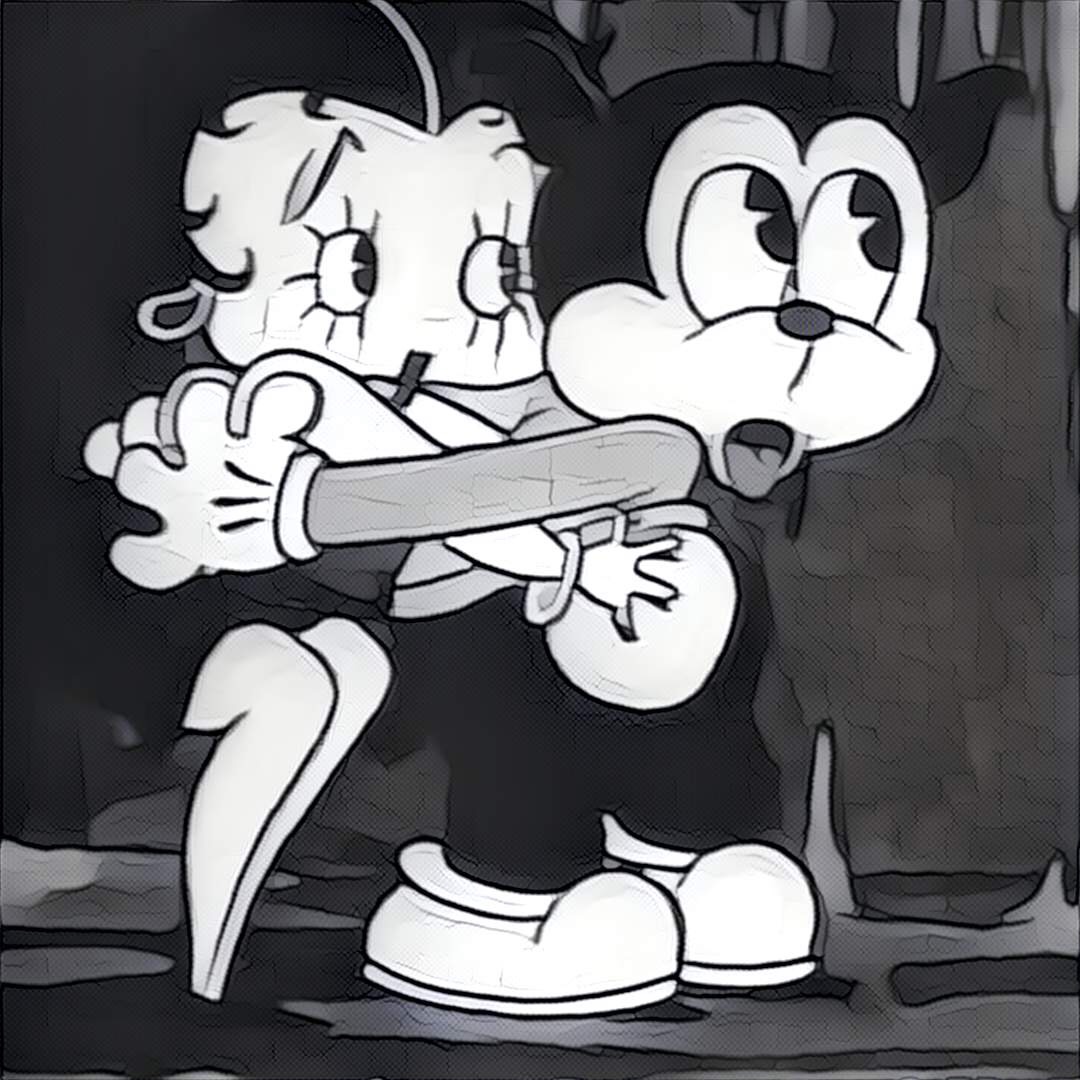
I will very briefly summarize the cartoon, as much as I am able. The main character is Betty Boop, the cartoon flapper that was one of the Fleischers' signature characters. She flees home after a protracted intro where her parents torment her, but, outside, with a dog name Bimbo (who, we are given to understand, is her boyfriend), she is beset by a singing walrus, whose voice is Cab Calloway's and whose movements were rotoscoped from Calloway's actual dancing. The walrus is soon joined by all manner of horrors, including ghosts, witches, and skeletons that dance about. Terrified, Betty returns home.

But this description cannot hope to convey the weirdness of the cartoon. The Fleischer's house style was stylized in a way that now looks primitive, and their characters exist in an extraordinarily lively and plastic universe, in which inanimate objects become animate and vice versa. This happens constantly and for no seeming reason -- a splash of ink will hoist itself up and run back to its inkwell, and a wooden statue will spring to life to comfort a weeping Betty. All of these moments are meant as visual gags, but, even before the skeletons started dancing, to my childhood eyes it all seemed perfectly nightmarish.

It also all seemed somehow essentially Jewish. Let me do a little inventory of how so:

1. The Fleischer Brothers, Max and Dave, were Jews; they were from an immigrant family from Kraków, although they were raised in the Brownsville neighborhood of Brooklyn. Despite the fact that their work seems primitive, as I said, Max was an exceptionally well-trained draftsman, having studied under the celebrated illustrator and educator George Bridgman. Dave, in the meanwhile, worked early as an usher for a vaudeville theater, and both brothers were raised, for a while, near Coney Island. The brothers were extraordinarily influenced by their urban, New York, immigrant Jewish upbringing, and their movies often reflected this, both in aesthetic choices (once you know the Coney island influence, the amusement park's graphics are the obvious source of their film's primitivism)  and content. The brothers made films that were urban, deliberately surreal, expressionistic, and sometimes astonishingly adult. The films were also very Jewish -- in this one, we meet Betty Boop's parents, and they are strongly accented Jewish scolds.

2. In one significant way, Betty Boop reads as a Jewish character. Although Boop was inspired by two iconic jazz age women, Clara Bow and Helen Kane, she was primarily voiced by Mae Questel, the Bronx-born daughter of Orthodox Jews who later went on to play a series of roles in live action films, almost always playing an old Jewish woman. Additionally, the Fleischers placed Betty in a world that constantly tips its hat toward its Jewish content -- it's astonishing how often "Kosher" signs, written in Hebrew, show up. In one cartoon, Betty is met on a tropical island by natives who cry out "Sholem Aleikhem!", apparently recognizing her as a landsman.  In a later cartoon, when Betty dreams of herself as a mermaid, she is met by a fish with sidelocks who speaks Yiddish.

3. Cab Calloway was not Jewish, but, if we were to play Lenny Bruce's "Jewish or Goyish" game, where he identified things by whether they seemed Jewish or not, Cab Calloway is Jewish. His operatic, swinging, minor chord jazz borrows from Jewish cantoral singing -- raised in Baltimore, which was then an immigrant port town, Calloway had long exposure to Jews, and in his autobiography claims that he even attended synagogues as boy. There was often a Yiddish inflection in Calloway's songs, sometimes overtly, such as his songs  “Utt-da-zay," based on a Jewish folk song, and “Abi Gezunt," which mixed Yiddish with jive talk.

Additionally, Calloway had a long, close relationship with his manager, Irving Mills, a Jew who was either from Odessa or Mahattan's Lower east Side, depending on who you ask. Mills cowrote at least one song with Calloway: None other than "Minnie the Moocher."

Calloway, and "Minnie the Moocher," have a long and almost subterranean reach in films by Jewish filmmakers. Calloway appeared as a sophisticated gambler in Normal Jewison's "The Cincinnati Kid," and later played the Blues Brother's mentor in the film based on the characters, directed by John Landis and featuring a showcase performance of "Minnie the Moocher."

But the song's, and the Fleischer film's, biggest influence seems to be on Jewish brothers Danny and Richard Elfman. I will detail the film they made together, "Forbidden Zone," in another essay, but suffice it to say the film seems to be an effort to make a feature-length version of everything upsetting about the Fleischer Brothers' cartoons, and leans heavily on the music of Calloway, including a performance of "Minnie."

As Elfman has gone on to be a film composer, the Calloway inspiration just keeps coming up, often in scenes that seem the most Fleischer-like: the dancing bones in "The Corpse Bride," which I have already written about, and the Oogie Boogie sequence in "The Nightmare Before Christmas."

And I get it, man. The Fleischer Brother's "Minnie the Moocher" climbs into you and sort of sticks there. Many years ago I wrote a short play called "BoyElroy," which consisted of a series of monologues inspired by cartoon characters. The play was first produced as a midnight show at the Blue Barn theater in Omaha in 1999 and then again at Manbites Dog Theater in Durham in 2007, and looks like it might be done again in Las Vegas next year.

Going back and rereading the monologues, there is one called "Betty," and it starts like this:

I left home
with only a note
to explain.
The note read,
simply:
You don’t treat
me so sweet.

This is literally cribbed from "Minnie the Moocher." It's the note Betty leaves her Jewish immigrant parents when running away. I didn't remember this fact until I rewatched the Fleischer cartoon a few days ago while preparing to write this essay, but perhaps I should not have been surprised. That little seven-minute short is like a virus, crawling inside Jewish artists and later exploding outward as some new piece of art.

And now you know about it, and you, too, have been infected.

Jewish Horror Films: The Corpse Bride (2005)


The animated film "The Corpse Bride" is a sort of mirror universe film to "The Possessed," in that the latter borrowed from a fake Jewish story and managed not to be very Jewish at all, while this film tried to strip away all Jewish content from an actual Jewish story and somehow failed.

The publicity around "The Corpse Bride" has always been maddeningly vague about the source of the story, and perhaps did not know. We are alternately told that it is Russian folk tale and a 19th century Jewish folk tale, and all of this is sort of wrong. There are a couple of versions of the original story, which tells of a groom who slips a ring onto what he believes to be old branches and discovers her has accidentally married a corpse. Perhaps the oldest is found in a 17th century Yiddish book telling stories of the city of Worms (so: German, not Russian, and 200 years older than is credited).

In this story, titled "The Demon in the Tree," the bride is, as you might guess, a demon rather than a corpse, so it is not quite the same story, but there is a similar tale from about the same time, originating in Palestine. That story is found in a collection of tales about the founder of Jewish mysticism, Rabbi Issac Luria, and is called "The Finger." In it, the bride is a corpse. (And, again, not a Russian story; the filmmakers seem to have fallen into the same trap many American Jews are also guilty of, of just assuming all European Jewish history takes place on a 19th century Russian shtetl.)

In the Issac Luria version of the story, the man flees, and, as he is to wed the next day, goes on with his wedding. The corpse arrives to disrupt things, insisting he already married her, and Issac Luria convenes a court to decide the matter. The rabbis decide that the man had already committed to his living bride, and so she gets first dibs, and the corpse screams and dies again, this time permanently. This is interesting, because the fact that Luria had to find a loophole for the living bridegroom suggests that is is not actually against Jewish law to marry a ghost, which I would not have expected.

Tim Burton's film hews pretty closely to this story, minus, of course, the rabbinic tribunal. He sets the film in what some viewers claim is Victorian England, but it isn't. It's some generalized Victorian European city. Sure, the entire cast speaks with British accents (including star Johnny Depp), but I have seen films in which Nazis address each other in English with perfect Received Pronunciation accents, so the English accent sometimes is just a placeholder for any country in Europe, which I think would surprise the English, who just made heroic and extremely short-sighted efforts to separate themselves from Europe.

The design of "The Corpse Bride's" little hamlet feels instead like one of those Bavarian villas that show up at the start of a werewolf movie, and this might as well be one of those old black and white monster movies for the amount of color in the village. It's a gray place, and apparently its only residents are the local lord and his family, who are titled but broke, and the local fishmonger and his family, who are untitled but rich. As a result, an arranged marriage has been struck between the daughter of the former (voiced by Emily Watson) and the son of the latter (Depp). Nobody is especially happy about this and it all goes rather poorly, and then Depp puts his ring on a corpse and it gets worse.

The corpse is voiced by Helena Bonham-Carter, making her transition from the delicate, pretty, posh characters she played in her early years to the moody and somewhat deranged characters she specializes in now, and I thoroughly prefer. She drags Depp down to the Land of the Dead, which is, it must be said, both more fun and better lit than Depp's gray hamlet, and they mostly hang out in a bar while a cabaret band of skeletons play.

There's more to the plot, but I won't detail it, although it involves a villainous murderer who is underwritten but manages to be entertaining anyway thanks to being voiced by Richard E. Grant, who can make any line, no matter how tepid, sound like a droll, very naughty in-joke. Instead, I want to discuss how the film ends up feeling Jewish despite the fact that it was made by filmmakers, especially Burton, who made no efforts to include anything Jewish, and probably would have done it poorly had they tried.

For one thing, there is the overarching theme of the interloper, the person who should have no privileges but is claiming them anyway. Depp's family are working-class strivers who have amassed money, and so are useful to the established gentry, despite the fact that they are despised by them. And then there is the corpse herself, who insists on her right to marry someone who should be off limits to her.

In a story set in Europe, this combination of alieness mixed with economic interdependency feels somehow essentially Jewish. European gentry did arrange relationships with Jews to prop up their faltering economies, and the average European would have found a marriage to a Jew to be just as unthinkable as a marriage to a corpse. In fact, on her mother's side, Bonham-Carter is descended from Viennese Jews and from a half-Jewish Spanish diplomat, while on her father's she is descended from a Prime Minister of the United Kingdom, and so her own family history reflects the complexities of these sort of relationships.

Bonham-Carter's corpse also has a sort of Jiminy Cricket character, except, rather than being a grasshopper that rides on one's shoulder, this is a maggot that lives behind the corpse's eye, which he will push out of her head occasionally to make a sardonic comment in the voice of Peter Lorre. I could reach for a metaphor here, as the Nazis loved to compare Jews to maggots, but I won't, because the metaphor was certainly not intended by the filmmakers. Instead I will just note that Peter Lorre was a Jewish actor, and so the presence of his voice, even in imitation, makes everything a little Jewish for me.

But I think the thing that gives this film an unexpectedly Jewish quality is the soundtrack by Danny Elfman. Elfman is a great recycler of antique sounds, and, for this film, he borrows from both hot swing music and the collaborations of Bertold Brecht and Kurt Weill. Especially in the barroom scenes in the Land of the Dead, there ends up being a Brecht feeling to the whole undertaking, or, at least, the feel of the movie "Cabaret," which always felt like Brecht by way of Broadway to me. The house band is presided over by a one-eyed skeleton singer in a raked bowler derby, apparently inspired by Sammy Davis Jr., and you sort of expect him to start singing "Mac the Knife," or, failing that, "Mein Herr." And, since he sings a Danny Elfman song, he basically sings something that sounds like both.

And there is one final Jewish influence I want to mention, and it's one I will explore in more detail in my review of another Elfman film, "The Forbidden Zone." This is the influence of the Fleischer Brothers, who were early and, by contemporary standards, primitive filmmakers whose films teemed with garish, sometimes nightmarish images, and whose work influenced Elfman. I know that Burton, who was a product of Disney, intentionally referenced a Disney short called "Skeleton Dance" with this film's skeleton band, but when you throw the Elfman soundtrack on it, instead the scene seems borrowed from a different cartoon, a Fleischer cartoon, in which the character Betty Boop is menaced by skeletons as Cab Calloway's "Minnie the Moocher" plays.

Come to think of it, I will do that film as a separate entry, even though it is only seven minutes long, because it has so many moving pieces, all of them, including Calloway, Jewish-infected, that the moment something comes up that seems to reference it, it suddenly turns everything Jewish. 

Especially when, as in this case, everything started out Jewish anyway.

Jewish Horror Films: The Possession (2012)


If you do a Google search for "Jewish horror film," 2012's "The Possession" is the first and most common search result. It is also the only explicitly Jewish film produced by Sam Raimi, who, like fellow horror directors J. J. Abrams, Larry Cohen, David Cronenberg, William Friedkin, Stanley Kubrick, John Landis, Eli Roth, Rod Serling, and Stanley Kubrick, is Jewish. And like the others, his Jewishness sometimes seems to inform his filmmaking, but is almost never explicit.

There really aren't that many Jewish horror movies, for some reason, despite the number of Jewish directors who make this sort of film, and a number of Jewish actors who regularly appear in horror movies, including Peter Lorre from the classic era of horror films and more contemporary performers like Eva Green, Daniel Radcliffe, and the recently deceased Anton Yelchin, all of whom staked out iconic roles in films of the uncanny.

I'm not quite sure why this is. Jews not only have a vivid folk heritage to draw from that is just teeming with demons, monsters, and curses, but also a sizable body of supernatural and occult literature. But for whatever reason this hasn't often translated to the screen.

I suspect the main reason "The Possession" wound up having Jewish content because it claims to be based on a true story, and that true story was inextricably Jewish. In fact, the story is closer to an online trend called creepypasta, which are urban legends, of a sort, that make the rounds through the internet, often without any attribution. This isn't that, exactly, but it's a closely related trend that I will call "haunted eBay." In this instance, an object on the online auction site eBay is promoted as being haunted, which gooses its value considerably, although most also include a "this is for entertainment only" notice, perhaps fearing legal action when it turns out the burned doll they sold is just a burned doll and not a spirit of the angry departed.

In this case, the haunted object in question was a wine casket. According to the original listing of the item, it was bought at an estate sale in Portland in 2001 and had been the possession of a concentration camp survivor. The family claimed the woman called the casket a "dibbuk box" and behaved superstitiously toward it. Opening it, the casket contained a few strange, seemingly totemic items, such as a wine cup and a sculpture inscribed in Hebrew.

At once, terrible things started happening: A break-in at the seller's store, the seller's mother suffering a stroke, etc. The item sold, and then resold, a series of sellers who all claimed to have had traumatic experiences upon owning the box, although I suspect this is actually an example of what I'll call "haunted object flipping," where an eBay reseller hopes to make more money off the sale of a supposedly haunted object by adding to the story.

And I love this story. I don't care whether the box was actually haunted or not. I love that there is a strange market for objects made special by urban legends, and that this has been supercharged by the web. I don't know what the movie version of that story might have been, but I would have enjoyed watching it.

This is not that story. "The Possession" instead follows the barest outline of the original story on the oringal eBay posting, with a child buying a Hebrew-carved box from and infirm old woman (possibly Polish, possibly Jewish, possibly a Holocaust survive, although all three are hinted at rather than made explicit, and, even then, barely hinted at.) The girl opens the box and all sorts of terrible things happen. And since this is called a dibbuk box, the film's screenwriters (Juliet Snowden and Stiles White) borrow a little bit from the Jewish story of the dybbuk, which is a ghost or malevolent demon that possesses people. So the little girl is possessed.

As every other critic has pointed out, a lot of this is cribbed from "The Exorcist," and not necessarily well. Even so, the film has its pleasures. Even though the dybbuk box is Jewish, the family at the center of the story is not, including the father. He's played by the gruffly handsome Jeffrey Dean Morgan, an actor I have always liked, and he limns his role with a crinkly-faced concern for his daughter. He also does something I approve of: He immediately believes something supernatural is afoot. I do not like movies where characters insist on behaving like skeptics, because, in my experience, the average human will immediately blame any door that blows closed on a ghost. We're not just inclined to believe supernatural experiences, we actively seek them out.

While the film was produced by Raimi, whose named was featured prominently in the promotional materials, the actual director was Danish filmmaker Ole Bornedal, and he brings a sort of stately formality to the film, making it almost a Danish modernist version of a horror movie: If this was an end chair, it would be sleek, elegant, and primarily functional. It hard not to wish Raimi were the director, as the movie could have used his signature hysteria. Nonetheless, the movie literalises the dybbuk's possession in an entertaining way: The possessed girl actually has a tiny monster living in her that occasionally makes efforts to emerge, most startlingly in a scene in which she examines the inside of her mouth with a flashlight and see two fingers dart up from the back of her throat.

The film also presumes that, because dybbuks are Jewish spirits, it will take a Jew to get rid of it, and so they bring in beatboxer and reggae singer Matisyahu as a sort of punky Hasidic exorcist. There's an entire scene set in Borough Park (presumably subbed in by a Vancouver neighborhood, as the movie was filmed there, and looks it) filled with be-shtreimeled Hasids sitting around a dimly lit, empty room, muttering darkly and unhelpfully about Jewish folklore. There is a rebbe in the center of this room, speaking Yiddish with the grim determination of somebody turning down a bank loan. The Hasids all leap back in terror when they see the wine casket, which is contrary to my reading of historical Hasids, who would have leaped toward the thing, stretching out wine glasses and crying out it was time to makh a tikkun.

I would have liked more of this sort of thing, but it is not forthcoming. Instead, we are left with the non-Jewish family in the basement of a hospital, with Matisyahu circling them with a tallis over his head, shouting Deuteronomy 6:5 in Hebrew, if I caught the Hebrew right, which is mostly directions for wearing tefillin and I did not know it could be used to exercise a ghost. Spoiler: After a few hiccups, the prayer works, and the dybbuk crawls back into his box, looking like an exceptionally crabby baby.

The film has a typically ambivalent coda, which I shall not spoil, but I was left hoping that there would be something else: After all, a non-Jewish family has just discovered they live in a Jewish universe, or at least the supernatural world is Jewish. What do you do with that knowledge?

I feel like you would have to become Jewish, wouldn't you? I mean, if tefillin prayers will send demon babies into wine caskets, there must be something to Judaism, mustn't there?

Maybe that's why there are not so many Jewish horror movies. Because for the audience to enjoy them, to suspend their disbelief, they must watch a movie set in a Jewish universe, where Jewish mystical and theological conceptions work, and are correct, and that's asking a lot of a mostly non-Jewish audience. Horror films are usually set in a world with no overarching theology, are set in a Christian world, or, in the case of folk horror movies, are set in a world in which ancient paganism is in conflict with Christianity.

This is not that. This is a story where gentiles are characters in a Jewish world, and, if there is one thing the past few years have shown, the majority is very rarely comfortable being relegated to being supporting players in any story. They can't see someone with a sign that says "black lives matter" without screaming "all lives matter," they can't see a women's only space without demanding to know why men are excluded, they can't stand to hear themselves described as cisgender, because how dare transgender people come up with a word to describe people who are not trans.

It's hard to tell a story set in the world of a minority, even when you make gentiles the main characters, as in this film. See what happens when filmmakers try to market films about the black experience to white audience members, and what happens when filmmakers cast women in lead roles in films typically dominated by men. It seems to me that it happens with horror films, even if the directors are Jewish, even if the actors are Jewish.

I'm going a little off topic here, but I wonder if this might also explain another phenomenon: That of the Jewish character who is instead presented as being Italian, as happened with half of the cast of Seinfeld and the entirety of Everybody Loves Raymond. Perhaps the fear is that audiences can stand Jews up to a point,  especially in comic roles, but don't want to have to inhabit a Jewish universe to do so. I just did a series of articles on films set in Jewish summer camps, and in almost every case the Jewishness of the film was subsumed almost to the point of invisibility.

I don't know. Maybe it's strange to want a movie in which Jewish victims are torn to pieces by Jewish monsters. I don't think so, though. I have done some film work in my life, including playing a chinless zombie in a movie shot in Waco and a zombie with an intact chin for an internet commercial shot in Los Angeles, and it's a lot of fun. Horror movies are fun, period.

Maybe Jews should get to have that sort of fun once in a while.

Jewish Summer Camp Movies: Indian Summer (1993)


There isn't much the 1993 film "Indian Summer" is remembered for. One of the stars, Kevin Pollak, used to mention the film in his comedy act, saying "Thank you for seeing it" to uncomfortable laughs from the audience, who did not see it. Pollak, who is a world-class impressionist, only has one story from the film: He used to call costar Alan Arkin's voicemail and leave messages in Arkin's voice, reminding him to buy food for the dog, which must have been bewildering for the older actor, who would not remember ever having made such a call. There is a thin line between comedy and gaslighting.

I don't know that I get to include "Indian Summer" in my list of Jewish summer camp movies. With something like "Meatballs," even though the camp in the film wasn't explicitly Jewish, it was made by filmmakers who attended Jewish camps, and so it's possible to argue that the film's camps are secretly Jewish. Not so with "Indian Summer" -- it's based on a real camp in Ontario, Camp Tamakwa, and Camp Tamakwa is not a Jewish camp. As far as I can tell, Tamakwa is instead the Platonic idea for summer camps, the real-world equivalent to the Khaki Scouts camp in "Moonrise Kingdom." It has the rustic cabins on a scenic lake, the faux-Indian mythology, the rugged American and Canadian back-to-natureness of the whole thing. There are no mezuzahs on the cabins, no guitar players working their way through "Ani V'Ata," no youth rabbis coming out on shabbos to lead services.

And yet there is a pervasive Jewishness to the whole thing, reflected in the film. The place was founded by a naturalist named Lou Handler, a Jewish former prizefighter from Detroit, and a Canadian outdoorsman named Omer Stringer. Although the camp is nondenominational, it has long drawn a significant number of its campers from the Jewish community -- even to this day, the camp's website says that "Most of the campers and staff are Jewish," and there are nondenominational services for the sabbath, but they are Friday night, when Jews have their shabbos services.

And, I must say, I find something Jewish in the sheer muchness of the camp, if you will. There is something exceptionally second-generation to it, to its dedication to an idealized vision of summer camp. This was a generation that often worked overtime to show they were as American as the next guy, and the results were that they were often more American than the next guy. So it wouldn't be enough just to go to camp. American Jews had to go to Camp, capital C, the most camplike camp ever.

"Indian Summer" was made by Mike Binder, who has had an unshowy but respectable career in Hollywood, and was a longtime veteran of Camp Tamakwa. As a result, of all the films I have written about so far, "Indian Summer" is the one that most carefully details the experience of campers, who are usually just sort of left in the background of these sorts of movies as the counselors and counselors-in-training get into R-rated hijinks. The film is essentially an essay of the folk traditions of Camp Tamakwa, from their private language to the various physical activities the counselors put the campers through.

There are, I should note, no actual campers in the film. Instead, the story is about former campers, invited back for a week by the film's Lou Handler, who is even called Lou Handler in the film, and is played with typically delightful and subdued eccentricity by Alan Arkin. Like at the real camp, the returning campers are a mix of Jews and non-Jews, although it can be hard to suss out who is who. The film's female cast is largely non-Jewish, but for the terrific Julie Warner, but they are the sorts of actresses who have played Jews, and who you're tempted to go to IMDb to see if they might not be Jewish after all: Diane Lane, Elizabeth Perkins, and Kimberly Williams-Paisley.

The men are less ambiguously Jewish, including Pollack, Meatballs-veteran Matt Craven, and even Italian-American Vincent Spano playing a character named Berman. The strangest casting choice is film director Sam Raimi as a klutzy camp gofer, although it did lead to me discovering that Raimi is Jewish and attended Tamakwa. (This may explain why his Spider-Man movies felt the most Jewish of all, despite starring Irish-American Tobey Maguire, and despite the fact that the next Spider-Man, Andrew Garfield, actually is Jewish.) Also on hand is Bill Paxton in the middle of trading in the unimpeachable weirdness of his early roles for the aw-shucks Texas leading man of his middle career, and nobody would mistake him for a Jew.

I don't really know what to say about the plot of the film itself, which is sort of like "Love Boat" at a summer camp, in that each of the characters has some sort of romantic entanglement. I don't think the film passes the Bechdel test, in that I don't think there is a scene where the film's women aren't talking about men, but, weirdly, the film's women are much more interesting than the men. With the exception of Pollak, who is a prankster, the remainder of the male cast are mostly amiable nobodies, while the women are generally sharp-witted and believably wounded. I don't know if there is an equivalent of the Bechdel test for a movie where the women are more interesting than the men, but this passes.

If I don't have much to say about the film's plot, I do find myself obsessed with the costume design. Writer/director Mike Binder takes great paints to render the awesome physical beautiful of  Algonquin Provincial Park, the location of the camp, as well as the rustic tweeness of the camp, and somehow found wardrobe that perfectly represent this. Arkin in particular is frequently seen in a striped duffle jacket that just seems like the coziest thing ever. The whole place doesn't so much look like a camp as a set designer's version of a summer camp, with characters dressed in a costume designer's version of summer camp wear. Apparently the wardrobe choices are accurate, so much so that former campers assumed Arkin was wearing Lou Handler's old clothes.

There is a thin line between Jewish camping and glamping, I guess.