Showing posts with label history. Show all posts

A brief history of Yiddish Omaha


 Omaha has been a city of many languages, part of a country of many languages, and those languages each tell their own stories. There was Yiddish, as an example. The language comes from the same linguistic source as modern German, called High German. But Yiddish developed into its own language in the 9th century, and, following Jewish migrations eastward, picked up a number of Slavic words and grammatical forms, as well as borrowing a number of words from Hebrew. Yiddish became the common language of the Jews of Eastern Europe, and, as the migrated to America, they brought the language with them.

It’s hard to know precisely when Yiddish first came to Omaha. There have been Jews in the city since at least 1856, but it is likely many of them were of German extraction, and probably spoke German, rather than Yiddish. We know that a large number of Jews from Ukraine came to Omaha after they were expelled from the city of Kiev in 1886, but their language goes unmentioned in local newspapers until October of 1879, when the Bee ran an article about a performance of “In Gay New York” that would appear at the Boyd theater downtown and featured a “novel Yiddish specialty.”

Notices like this would continue to appear, such as one from June of 1899, when the World-Herald ran an ad for the Trocadero vaudeville theater of 14th Street downtown, which featured a performance by Julius Rose, who offered Yiddish ragtime songs and dances.

It is likely these performers were doing something called “dialect comedy,” in mostly English but with thick accents, but it does indicate that the character and language of the East European Jews was starting to get some stage time. Indeed, one such performer was local: Carl Reiter, manager of the Orpheum, would occasionally appear onstage performing “Yiddish” stories.

Local use of Yiddish as a daily language first found its way into the papers in 1903, in a World Herald story titled “Looking to Nebraska as a Haven of Refuge.” The story detailed the plight of Russian Jews, who were then experiencing anti-Semitic violence, and their need to find American cities that could accept them as refugees. According to the US Census, and by 1930, Omaha would home to more than 2,000 Jews from the former Russian Empire.

Soon, we find our first performance entirely in Yiddish. In June of 1904, a performance of  “Alexander, Crown Prince of Jerusalem” took place at the Krug theater, formerly the Trocadero; the theater would be home to similar events for years to come. Also in 1904, the World-Herald reported a new police officer in the downtown Market District would be expected to understand a variety of languages, including Yiddish. By 1906, local Zionist meetings in English and Yiddish were reported at 17th and Farnam.

1909 brought a Yiddish giant to Omaha: Boris Thomashefsky, one of the biggest stars in Yiddish theater, who was responsible for the first professional Yiddish theater production in America. Thomashefsky appeared at the Burwood Theater downtown, where film star Harold Lloyd made his debut. It must have gone well, as he was followed by another legend of Yiddish theater: Jacob Adler in 1910, whose daughter Stella taught Method Acting to Omaha’s Marlon Brando, who also picked up some Yiddish and used to read Yiddish newspapers in New York.

In 1911, the World-Herald listed three Omaha synagogues where the primary language was Yiddish, all downtown, two of them new. In the story, a local rabbi estimated there were 1,000 Yiddish speakers in the city. In a follow story, the paper opined within a generation or two, Yiddish would be a dead language.

It isn’t, as there is still a vibrant Yiddish-speaking community in the United States, but the language usage has dwindled in Omaha. There was a film in Yiddish, 1975’s “Hester Street,” that was largely in Yiddish and was written and directed by Omaha Joan Micklin Silver, and the town still sees Yiddish performance, including Mandy Patinkin, who sings traditional Yiddish songs.

It’s too early to count out Yiddish as a language. Studies have shown a growing interest in the language, especially among a younger generation of Jews. There may yet be a time when Omaha’s Market district, now it’s Old Market, is home to multiple languages, and Yiddish will be among them.

I Married a Jew


I am going to tackle an essay now that made the rounds a few years ago and originally dates back to 1939, so I'm not exactly treading new ground here. The article is titled "I Married a Jew" and was published in the Atlantic, which put its archives online in 2008, leading to the rediscovery.

I think it enjoyed  attention a few years back because the author, a liberal-minded young woman, manages nonetheless to be spectacularly wrong about just about everything. She's even wrong about Hitler, lecturing her Jewish husband that there is nothing especially notable or unique about the man, and that Jews are just being oversensitive about the subject.

Indeed, the whole essay is essentially one long harangue about the failings of Jews, so much so that New York magazine columnist Jonathan Chait called her "the world’s first recorded Shiksplainer."

The story became popular enough that The Atlantic itself felt a need to respond, in the form of a column by staff writer Olga Khazan that essentially treats the whole article as a bizarre artifact of an ancient time. "It’s now basically an after-midnight SNL sketch in magazine-article form," she wrote, later adding that the story is a "a powerful remembrance of how much more hateful our world was just a few generations ago."

Faraway and alien

And the original story does seem faraway and alien, despite having been written not-so-very-long ago -- it was authored a year after my father was born. And yest, especially in the past few weeks, it does not seem so very, very faraway or alien. It's an essay that just reeks with privilege, and I don't think privilege has gone away.  If anything, I think the past election, in which a candidate pushing a white nationalist worldview was elected president, shows that not only is this sort of privilege still around, but it can decide the fate of nations.

What strikes me now upon reading the essay are not the things that seem different, although they are worth noting. She is adamant that Jews are a different race, which her Jewish husband agrees with. In general, this is not a widely held worldview anymore, except among rabid antisemites. She quotes her mother's concerns that her marriage to a Jew will bar her from certain circles, but that isn't so much the case anymore. The mother also declares Jews to be Oriental, and not only has the meaning of the word changed quite a bit (at the time it included the near Middle East), but the word has fallen out of popular uses except to refer to rugs.

She also declares Picasso a Jew, for some reason, and doesn't think much of him. She calls a synagogue a Jewish church, which is crazy. She seems to think it is literally impossible for someone from China to assimilate into American society, which was then a popular stereotype that doesn't get applied to the Chinese as much nowadays; no, instead we hear it is Muslims who are incapable of assimilating.

And, finally, as mentioned, she minimizes the threat of Hitler, who on January 30th of 1939 had announced his intention to annihilate the Jewish race in Europe. Writing the same year, the author of "I Married a Jew" tells her husband that "a hundred years hence the world will no more call Hitler a swine for expelling the Jews than it does Edward I of England, who did the same thing in the thirteenth century." In the entire history of predicting things, this may the worst prediction anyone has yet managed, and the fact that she had the temerity to lecture a Jew about antisemitism, its risks, and how real its threat is -- well, I just can't. I can't.

But what stands out for me is how little room she makes in her life for Judaism. She boasts that her husband does not look Jewish, does not have a Jewish name, and is not religious. It's the only thing that convinces her nakedly antisemitic mother to approve the marriage. The author learns almost nothing about Judaism, although she boasts that she has read the Old Testament, as though reading a document that is considered sacred to Christians is in some way a favor to the Jews.

There is a moment when she tries to describe the Yiddish used by her husband's family, and she manages two actual Yiddish words -- meshuge, meaning crazy, and tzimmes, a sweet stew. But then she also says chasseh, and I have no clue what she's trying to say, and I grew up with exactly the sort of Yiddish she describes and have studied it as a language for almost a year. In fact, if you do a Google search, the second result for "chasseh" is this article, and the first is for a Jewish history project from Maine that describes a man speaking Yiddish with a thick Mainer accent, so that the word for pig, chazzer, is rendered chasseh. Maybe that's what she's hearing.

Anyway, she doesn't like the Yiddish. Well, not the Yiddish, per se, but instead the fact that the husband's family "make no concession to me as a Gentile." She continues: " They go about their Jewish ways, tales of their Jewish problems, and consider me aloof if I do not enter whole-heartedly into all this and become as one of them."

Let me remind you of the thing that made the husband appealing to her: The fact that he didn't seem especially Jewish. There is no indication that she has made any room for his Jewishness in her life. But, then, it is pretty clear she thinks she shouldn't have to. Here is her harangue on the Jewish character:

Had the Jews seized these opportunities for amalgamation, eventually all the barriers would have been broken down. But the Jews did not seize the opportunity. They chose to retain their identity and remained in intact as before. Today it is America that is offering the children of Israel the greatest opportunity in history for absorption.

This paragraph is not unique. It's a subject she returns to again and again, almost obsessively -- indeed, she refers to her husband as "lapsing" back into Jewishness when he is around his family, which  feels alien to her. "Separately I am fond of them; individually I welcome them to my home; but in a large group of them I feel like a fish out of water," she complains.

And this is the crux of it. This is the privilege. She has grown up in a world where she has never been made to feel the outsider, and when she very briefly experiences it, when she very occasionally enters an environment where her concerns, experiences, and worldview are not dominant, she recoils. Never mind that this is how her husband's family feels all the time -- that is their own fault, as they are clannish, foreign interlopers.

She gestures at sympathy at one point, saying that we must meet halfway, that Jews must not be so entirely Jewish and Gentiles must not be so entirely Gentile, but she offers no concessions of her own. Well, one. When her husband irritably reminds her that many Jews have assimilated but been subjected to antisemitism anyway, she allows that this as true. But, when it comes down to it, whose fault was it?

The Jews. The Jews did not seize the opportunity. They chose to retain their identity and remained in intact as before.

Echoes of fascism

It is almost impossible not to hear echoes of fascism in these words. Here are two quotes, and I will not tell you whether they are from the article or from Adolf Hitler. See if you can determine who said what:

"The best characterization is provided by the product of this religious education, the Jew himself. His life is only of this world, and his spirit is inwardly as alien to true Christianity as his nature two thousand years previous was to the great founder of the new doctrine."

"The Hebrew religion must be divorced from the promulgation of that race consciousness which every synagogue and temple considers as important a part of Judaism as prayer; it should be mortified at least to the point where it does not belittle the great ideal of western culture and civilization: Christ."

It's the latter. I know that this is a little unfair, as typically Hitler was a little more blunt about his antisemitism, referring to Jews as vermin and enemies of the state. But both started from the presumption that Jews are interlopers, and that their refusal to assimilate was the crux of the Jewish question -- the difference between Hitler and our more tolerant Gentile wife is that the former did not think Jews could assimilate, by virtue of being a degenerate race, while the author of "I Married a Jew" thinks Jews can assimilate, but choose not to, and therefore encourage institutional antisemtism.

But both share a core belief: That the problem is the Jew. That antisemtism isn't a pernicious evil perpetrated by Gentiles upon Jews, but instead a predictable response to the fact of Jews. Particularly, that there is something about the Jewish experience that, by its clannish nature, makes it hard to trust the national identity of the Jew. "A few cultural, intellectual Jews announce they are first Americans and then Jews, but they are voices crying in the wilderness," she complains.

What is the source of her sense that there is something suspicious about the Jewish experience in America, something that might be contradictory to the national interests of the country? She is never especially clear on this, but, based on her essay, I would guess it is this:

She thinks her experience, as a Gentile woman in America, is the American experience. When she is among unassimilated Jews, not only does she encounter an experience that is unlike her own, but one that does not defer to her experience.

It never occurs to her that this is what it is like to live in a multicultural America, because she was not witness to a previous generation's conflict, in which the loyalties of German Americans were seen as suspect, and were suppressed. No, she grew up in an America where German-Americans were comfortably mainstream. As a result, when she finds herself in a situation in which she feels her own experiences being marginalized, she makes an amazing leap: She is not sure she can trust these people as Americans.

But it's not that amazing a leap. The idea that the refusal of Jews to assimilate makes them a suspect people, an invading nation with Jewish loyalties, is a classic antisemitic trope -- it was the very one that Hitler used to justify the Final Solution. Our author grew up with a mother who was nakedly antisemitic ("Jews are sensual, aggressive, ostentatious, cunning—that is a heritage they can never overcome. They accomplish things in business because they are shrewder than Christians and never hesitate to seize an unfair advantage."). More than that, she grew up in an American that was more nakedly antisemitic than now. She absorbed that antisemitism as fact and, amazingly, decided to write an entire column in which she lectures her husband about the problems with Judaism, using these antisemitic arguments.

Not so dominant

With the rise of the belligerently antisemitic so-called alt right, it is tempting to look at how they use these classic antisemitic tropes. But I think most Americans are closer to "I Married a Jew's" author, and I think we're seeing a lot of this same sort of reaction right now. The dominant majority is not so dominant anymore, and soon won't be a majority -- by 2060, it is projected that non-whites will be the majority in this country.

That's still a ways off, but we're certainly seeing the effects of white people no longer feeling like they are being pushed out of the center. It shows itself whenever a minority asserts themselves in any way. "Black Lives Matter" is immediately responded to with "All Lives Matter," which must be understood as saying "How Dare You Craft a Slogan That Doesn't Include White People." Abigail Fisher insists, without evidence, that she was passed over for acceptance into the University of Texas in favor of less qualified black people, and takes the case to the Supreme Court. Pharmacists refuse to provide birth control to patients, and county clerk Kim Davis refuses to issue marriage licenses to same sex couples, and both insist that they are not discriminating, but instead are being discriminated against, because their religion gives them the right to treat other American citizens unequally.

Never mind that it doesn't. But you'll note that, despite the fact that these people are violating the law, nobody ever questions whether or not Christianity is compatible with being American, or demands that Christians assimilate.

When I say Trump ran on a platform of White Nationalism, I mean that his speeches were meant to assuage white Americans that this is a white nation, and inflame their anger than it is becoming increasingly less white. Consistently, he targeted non-whites, particularly (but not exclusively) Mexicans and Muslims.

I won't spend any time on arguments that he reached his audience because he addressed economic insecurities, as he had no actual policies to address this. Instead, he ran on a platform that looked for scapegoats, and found them, and they were almost entirely people of color. He appealed to national humiliation, but his voters weren't economically humiliated -- Trump's supporter had a median income of $72,000, which is $20,000 higher than the national median income and $48,000 higher than the poverty rate for a family of four.

No, they were responding to racial humiliation. Trump painted undocumented Mexican immigrants as criminals and rapists, despite the fact that these immigrants commit, on average, less crime than American citizens. Trump painted Muslims as either being violent extremists or participating in a support network for violent extremists, despite the fact that your average American is almost totally unlikely to experience political terrorism, and if they do so it will likely be at the hands of a white extremist. 

Trump opposed globalism, but he almost exclusively pointed to Mexico and China as places where US manufacturing jobs have gone. But the truth is, while the US did lose about 5 million factory jobs since 2000, most of them didn't go overseas, but instead were lost to increased automization. Brown people didn't take the jobs; robots did. 

But white people aren't afraid of robots. Not the way they are afraid of brown people, afraid of being pushed out of the center. And it was a winning strategy -- although Trump did not manage to win the popular vote, the Electoral College, which was designed to protect the interests of slave owners, aligned with white nationalist concerns in this election, a stunning demonstration of both the tenacity of racism and the longterm effectiveness of institutions designed to support racism.

Fragility

I suppose the thing that I find most illuminating about the essay it is fragility. That's a word that's enjoyed a lot of currency lately, and I think it is the right one. She presumes her privileged is somehow natural and earned, and that the experience of white Christians is the American experience. She spends almost all her time luxuriating in this while witnessing the real-world oppression of her husband. He is, as an example, denied the opportunity to join a fraternity due to his religion, and that's just one of the many opportunities that were denied to Jews in the 1930s. And this happens despite the fact that he does not look Jewish, does not have a Jewish name, and is not religious -- for all practical purposes, he has assimilated away his Judaism, to such an extent that the author admits the subject almost never comes up.

And yet, for the very brief moments when she is with his family, and her experiences are no longer assumed to be dominant, she becomes tremendously unhappy. So unhappy that she had to write an entire essay for The Atlantic discussing how Jews desperately need to be less Jewish or antisemtism will continue. 

And it is worth reading this essay knowing that the author is still with us, or at least her worldview is. There are a lot of people in America like her, who presume the experience of being white and Christian is the American experience. She couldn't stand hearing a little Yiddish -- imagine how hard it would be for someone like her to be in America that constantly challenges her dominance, her centrality, her status.

And we Jews must be mindful of this, both because we are still not so close to the mainstream, as the brutal antisemtism of the alt right reminds us, but also because we are close enough to the mainstream to likewise be threatened, likewise be fragile. 

When we hear our neighbors described as incapable of assimilation, or as having divided loyalties due to their religion, or as being unwelcome interlopers undeserving of the same rights or opportunities, we should remember that the same was said of us.

It was not so long ago. Some say it still.

The Negation of the Diaspora


Here's a fun little experiment: If you're studying Hebrew, try speaking in an Ashkenazi accent and see what happens.

I tried this experiment myself in college. I had left school for a few years and moved to Los Angeles, and, while there, hanging out in the delis and watching the frum Jews in the Fairfax neighborhood, I found myself curious about my own family's background. I developed a terrific interest in the history of the Jews in Europe, especially in Eastern Europe. This is where my grandparents came from, and yet I felt like my education had skipped something, despite my having attended a Jewish high school, Jewish summer camps, and years of religious education through my synagogue.

No, the story of Judaism that I learned basically looked like this: Bible. Destruction of the Second Temple. Babylonian Talmud. Holocaust. Founding of the State of Israel.

There were hints of European history in there -- some mention of the rise of Hasidism, some tellings of the tale of the Golem of Prague, a few other things, atomized moments of history, unmoored in time and unsettled in location.

When I returned to college, it was to pursue a degree in Jewish Studies, and I found myself especially focusing on East European Jewish history. It felt like it was my history, in a way that was more intimate and direct than the ancient Israeli story I mostly grew up with, and the story of modern Israel, which was not my story. I was not an Israeli, ancient or modern. I was an American Jew whose grandparents were Eastern European Jews.

I started taking Hebrew again. The first day of class, students are generally assigned a Hebrew name, or, if you're Jewish, you probably already have one. I was Tzvi in my synagogue's Hebrew school classes, but I had no desire to be Tzvi again. I already had a Jewish name, Max Sparber, and was named after my uncle Max, a dealer in rare books in New York, many of them Yiddish books or books on Judaica. There was no reason for me to trade out my actual Jewish name for an artificial Hebrew name. I don't know why I rankled, but I did. I have a better idea now.

I also insisted on using the Yiddish spelling of my name rather than transliterating it into Hebrew. My teacher fought me on this, but I suppose I gave her the choice of either letting me use the name I wanted and spell it how I wanted or of docking my grade for this odd rebellion. She chose to ignore it.

I had also learned how to read Hebrew using an Askhenazi pronunciation, the pronunciation used by European Jews, which dates back to at least the 11th century, and might be older. It is not the accent preferred by speakers of modern Hebrew. That is the Sephardi pronunciation, associated with the Jews of Spain. It was the accent chosen by Eliezer Ben-Yehuda, the founder of modern Hebrew, in part because it was the accent used by the Jews in Palestine, and apparently also because he just preferred it, despite hailing from what is now Belarus.

And, with that decision, and with the development of the State of Israel, a modern variant of the Sephardi accent came into prominence. It's the accent I was taught in religious school, it was the accent used in my Jewish high school, and it was the accent used to study Hebrew texts and teach Hebrew in college. I only heard the Ashkenazi accent when I heard my father and grandfather pray.

The accent

About this time, I started to use the Askenazi accent myself when I went to synagogue and used it when reading religious texts at college. And sometimes I would use it in my Hebrew class. I guess I felt about it the same way I felt about my name -- that it was a more authentic expression of my Jewish heritage, and I should be allowed to use it.

My teacher did not agree and corrected me every time. I understand her viewpoint: She was teaching conversational modern Hebrew, and the Ashkenazi accent is not preferred in modern conversational Hebrew.

I had my own viewpoint, which I didn't then know how to articulate: I was not interested in modern conversational Hebrew. I had no plans to visit Israel, I had almost no interaction with Israeli culture, and I knew almost no Israelis. I was studying Hebrew to study religious texts, and the accent I did this in didn't really matter. Actually, it did matter to me. It mattered that I studied them in the same accent as my family had.

By the way, my teacher was wrong. All teachers who insist the Sephardi accent is the proper modern Hebrew accent are wrong. There is a small but significant number of Israelis who use the Ashkenazi accent, albeit generally these are Haredi Jews or older European Jews. It's a minority accent in Israel, but is used, and the accents are mutually comprehensible, so there is no absolute reason why a modern Jew could not learn an Ashkenazi accent while learning modern conversational Hebrew. We just choose not to, and discourage those who choose to do so.

The negation

This didn't happen by accident, by the way. It is the product of a philosophy that has threaded its way, invisibly and in subterranean ways, throughout much of modern Judaism. It is a philosophy that, appropriately, has a Hebrew name, and that name is shlilat ha'galut. In English, it translates approximately as the Negation of the Diaspora.

I am going to turn to Wikipedia to sum up the philosophy, as I think they do it about as well as I could:

The negation of the Diaspora (Hebrew: שלילת הגלות‎‎, shlilat ha'galut, or Hebrew: שלילת הגולה‎‎, shlilat ha'golah) is a central assumption in many currents of Zionism. The concept encourages the dedication to Zionism and it is used to justify the denial of the feasibility of Jewish emancipation in the Diaspora. Life in the Diaspora would either lead to discrimination and persecution or to national decadence and assimilation. A more moderate formulation says that the Jews as a people have no future without a "spiritual center" in the Land of Israel. 
For those of you not familiar with the term, diaspora essentially means "dispersal," and there are a lot of Diasporas in the world -- as an Irish-American, I am also part of the Irish Disapora. Here's what it refers to in this case: The Jews used to have a homeland, the Land of Israel, but were forcibly dispersed in a series of exiles, culminating at the end of the First Jewish–Roman War, when Jerusalem and the Second Temple were destroyed and a significant portion of the population was exiled.

The destruction of the Temple was an extraordinarily traumatizing and transformative event for Jews. It took away the spiritual center of  Judaism and forced the development of smaller, community based approaches to Judaism, including the rise of synagogues and rabbis and the codification of Jewish law. Modern Judaism, as we know it, was created in the Diaspora, which, in Yiddish, is called the Galus. It was a religion of exile, a religion that constantly look both back to the Israel that once was, at least in myth, and an Israel that we hoped would one day be, with the arrival of a messiah and a return to the Holy Land.

As you can see, embedded into Judaism was the idea that this exile was temporary -- that Jews are actually displaced Israelis, waiting for the opportunity to return, and if it didn't happen in life, it would happen after death, with something called the quickening of the dead, when all deceased Jews would return to life with the arrival of the Messiah and join him in Jerusalem. Nowadays, this is a largely undiscussed aspect of Jewish philosophy, in part because many modern Jewish movements have replaced the idea of a literal messiah with the hopes for a messianic ideal, a future of justice and peace. And it may go undiscussed because it gets very weird, as ideas about the messiah got wrapped up in Jewish mysticism, and ends up seeming like a collection of oddball folk stories and virtually incomprehensible metaphysical discussions. I mean, in some tellings, the messiah will sacrifice a giant sea-monster, called Leviathan, and a giant land-monster, called Behemoth, and maybe even a giant bird, called Bar Juchne, and then ... well, we just roast them and eat them, like some sort of eschatological barbecue.

If it goes seldom discussed now, I cannot overstate how important the idea of the coming of the messiah and the return of the exiles was to the Jews of the Galus. It was a constant obsession, and that obsession leaked into Zionism. The idea of a literal messiah was replaced with messianic hopes for the reborn land of Israel, but you find many of the same ideas, especially those of the return of exiles and the end of Galus. The Disapora was not merely temporary for many Jews; it was temporary and terrible, a time of poverty and wandering, where everywhere we went we were treated as aliens, and the population inevitably turned hostile and murderous.

Add to that the fact that one particular part of the Galus, the mystical, religious, squabbling, Yiddish-speaking Pale of Settlement, was sometimes treated with contempt and embarrassment by the Jews of Central and Western Europe. Yiddish was seen as not so much a language as a degraded German jargon, and the unassimilated Eastern European Jews were often presented as being uneducated, unwashed, and superstitious. This had particular impact on American Jews, as the major institutions of American Jewry were largely created by assimilationist German Jews who barely had any interest in maintaining their own culture, and positively recoiled at the culture of the Jews of Eastern Europe. It wasn't much better in Israel, where there was an unfortunate tendency to see European Jews as somehow being weak for having suffered antisemitism and a Holocaust, which left a strong desire to leave that world behind.

The results are that, with the exception of Haredi communities that basically playact at still be in 18th Century Poland, modern Jews have largely rejected the Galus, even though most of us are still in it. There are almost 6.5 million Jews in Israel. There are seven and a half million Jews in the rest of the world, including almost 5.5 million in the United States alone. The Diaspora experience has proven not to be temporary, but ongoing, and Israel is undeniably a center of the Jewish experience, but is one of many. In fact, there was a Jewish philosophy that developed parallel to Zionism, one that we now call ethnic nationalism or diaspora nationalism, which focused on Jews maintaining a unique identity while still in the diaspora, but while pursuing the same rights and responsibilities of whatever nation they are a part of. It's strange that this approach is currently so neglected, because this is actually the experience of most Jews in the world, as well as prefiguring a lot of modern discussions about race, ethnicity, and religion in a pluralistic world.

The dreidel

If you're a student of Yiddish, you start wondering why American Jewish institutions rejected Yiddish. After all, the Jewish community has been uniquely skilled at maintaining historic languages, teaching Hebrew and Aramaic over periods of thousands of years beyond when those were spoken languages. It was even possible for me to study Syriac in college, and I did so as part of my Jewish Studies program, which did not offer Yiddish.

Jewish things don't fade naturally; we tend to preserve them, even when they weren't originally Jewish. You'll still find Jews playing mahjong, a game they learned in the 1920s, while refusing to speak Yiddish, which survived and actually flourished in the United States until the 1950s. Yiddish did not simply fade. It was deliberately allowed to fade, and, not infrequently, helped along the way. Examples of this erasure abound, but I'll give just one.

On Hanukkah, Jews spin a little top called a dreidel. It is a gambling game: The dreidel has four sides, and each side has a letter on it, and each letter causes a different outcome: You might add to a pot, or take out of a pot. The letters are Hebrew, and they are nun, gimel, hey, and shin. I was taught this was short for a Hebrew phrase, and everybody I know was taught the same: Nes gadol haya sham, "a great miracle happened there," referring to a holiday miracle involving olive oil and a gold candelabra.

But it doesn't mean that, not originally. The letters are short for Yiddish words. Nun means nisht, or none. Gimel means gants, or all. Hey means halb, or half. Shin means shtel ayn, put one in. And that's the way the game is played. It's a European game called teetotum, which is played the same way, and was simply borrowed by the Jews. The whole "great miracle happened there" explanation didn't happen until the dreidel became primarily associated with Hanukkah. I haven't been able to track down precisely when this happened, but I have not been able to find any mention of the toy associated with the holiday from the 19th century, and the first American reference to both dreidels and Hanukkah I find is from December 17, 1916, from the Jewish Daily News of New York. The earliest reference I find to the letters meaning "A Great Miracle Happened There" is much later, in 1951, in an article in Canton, Ohio Repository. The Hebrew translation does not appear in print in a book until later still, in 1978, in "The Jewish Party Book" by MaeShafter Rockland.

(Note: Since writing this, I located a reference to dreidels being used on Hanukkahthat dates back to 1864, from a letter to Leopold Low, saying that the toy, here called a "trendel," was then associated with the holiday, and following this up I discovered an entry in the Jewish Encyclopedia that clarifies the relation between the dreidel and Hanukkah: In the Middle Ages, rabbis passed decrees against gambling games, but these were lifted on intermediate holidays and Hanukkah so long as these games were not played for money.)

Note that these two references come after the creation of the State of Israel. Hanukkah had been a relatively minor holiday, but, because it happens about the same time as Christmas, it grew in popularity as a sort of Jewish alternative to the Christian holiday, especially in America during the 20th century. Parallel with this was the development of Zionism, and while Hanukkah is not an explicitly Zionist holiday, it is one that celebrates the Maccabean Revolt against the Seleucid Empire's influence on Israel in 167–160 BC. With the rise of Zionism and especially with the formation of the modern state of Israel, Hanukkah took on new significance, and while I can't say with any certainty that the Hebrew version of the letters of the dreidel date from this time, I do find it unsurprising that this is when we find evidence that Hebrew was being favored over Yiddish -- indeed, the Yiddish interpretation of the letters is now entirely absent.

Erasure

So it is. So we find Yiddish being erased, decade by decade, an ongoing negation of the diaspora that, in this instance, replaces Yiddish with Hebrew and turns a European Jewish toy into one celebrating Israel. This has happened subtly, invisibly, for a century or more, and continues to this day, where the experience of Jews in the Galus are invisible or secondary. Here's a quick example:

There are a series of camps in North America called Habonim Dror that have taken steps to develop a gender-neutral form of Hebrew, which is a language that has little flexibility for the nuanced understanding of gender that has developed in the past half century. This is in response to a real need: The camp had campers who did not fit Hebrew's strict binary. This is also a need in the larger American Jewish community, as there are branches of Judaism, particularly Reform, that have taken enormous steps to be as inclusive as possible in their services.

According to the Washington Post, this has received criticism from alumni, who claim the camps are "teaching the children fake Hebrew that they won’t be able to use in the outside world." But of course they can use this Hebrew in the outside world. It's very possible to take the experiments of this camp and apply it to the synagogue. It's a response to a real need experienced by Jews in the Diaspora (and not just in the Diaspora; this discussion has also happened among Israeli Jews.)

I got in an argument about this on a discussion forum with an Israeli. "Your influence on the Hebrew language is directly proportional to the frequency at which you use it to criticize a driver's competence on Ibn Gavirol Street," he told me, which could not be more clear an expression of the Negation of the Diaspora. This wasn't even a real discussion, he argued, because it was happening at some American camps, but he had not yet heard any Israelis call for such a thing.

Let me be clear: I don't care what Israelis think about what American Jews do. If we want to invent our own fake Hebrew so that we don't exclude members of our community, we are free to do so. Not only did we not disappear once Israel became a state, we did not stop mattering once Israel became a state, and Hebrew is does not belong exclusively to Israelis, but is something used by American Jews that sometimes is adapted to American needs. We get to do this.

Our history did not stop mattering. It must be abundantly obvious at this moment that the Negation of the Diaspora was as much a myth as grilling up Leviathan at the end of time was a myth. Not only did the Diaspora not end, but it is entirely possible to maintain a Jewish identity and pursue being an equal member of society outside Israel. It is possible to be a Diaspora Jew and have a Diaspora Jewish identity -- in fact, I would argue it is vital to be able to develop such a thing, because the Diaspora is not going anywhere.

Part of the reason Yiddish appeals to me is that it is one of the languages of Diaspora Jewry. My name is not Tzvi, it is Max Sparber, after a Yiddish bookdealer, from a family of East European Jews, and we did not speak modern Hebrew, and, when we used the language, it was with the wrong accent. And I'm never going to let someone tell me otherwise again.

Jewish Genealogy: In Praise of the Baal Shem Tov


Let me take a moment to map out my family tree leading back to Ze'ev Wolf Kitzes, my 8th great grandfather, the Hasid I am investigating at the start of this project. It goes like this, listing only direct descendants of Kitzes and not their spouses:

Max Sparber -> Claire Kestenbaum -> Ida Kitzis -> Isaac N Kitzis -> Noah Kitzis -> Chaim Nachman Kitzis -> Wolf Ozer Kitzis -> Israel Kitzis -> Nachman Kitzis -> Ze'ev Wolf Kitzes

I pieced this together from an online genealogy of Wolf Kitzes, and, who knows, it might be completely wrong. I suspect it's pretty accurate, though, as even when students of the Ba'al Shem Tov didn't create dynasties of wonder rabbis, as with Kitzes, their families still tended to be pretty diligent about maintaining the family tree. It's something called "yikhus" in Yiddish, a sort of pride in the accomplishments of ancestors. I will continue to investigate the family tree as I am able, but it is a starting point.

I should note that, at the moment, I have no idea how I know that I am descended from Kitzes. I had thought my mother told me, but she insists that she never did, she found out from me. I feel as though I have known since I was in my teens, when I was in the Jewish high school, and I expect it is likely that someone else in her family told me, but we're lost as to who that might be. Nonetheless, we do fit onto the Kitzes family tree perfectly as it is, and this isn't the sort of thing I would just make up as a child. I was a strange child, but not that strange. This is another area I will continue to investigate.

And one more quick note: As I am adopted, there probably will be some who do not feel it is appropriate for me to claim Kitzes as an ancestor. After all, I have biological ancestors, all from Ireland, and I claim them too.

Thankfully, I do not need to care what these people think. I am not trying to claim leadership in a Hasidic dynasty, as Kitzes established no such dynasty. I am not trying to marry into a Hasidic family, or claiming property, or anything where my biological relationship to Kitzes might be important. I consider myself to be a grandson, and I doubt he would have taken issue with that, for reasons I shall detail. But, as for now, I simply need remind people that the Talmud, in discussing several children that King David is said to have adopted, declared that "Whoever brings up an orphan in his home is regarded, according to Scripture, as though the child had been born to him."

Onward. As I mentioned in my previous post, there are a number of stories told about Wolf Kitzes, and my goal was to start with those stories and determine where they came from. This week, I begin with what must be considered the ur-text of Hasidic Judaism, a book called "Shivhei ha-Best," or, in English, "In Praise of the Baal Shem Tov." I purchased a copy in translation, an academic work produced by Dan Ben-Amos and Jerome R. Mintz in 1993.

The original book was written in a sort of primitive Hebrew in 1814, originally with no credited author, but in later editions credited to Rabbi Dov Baer ben Samuel. Rabbi Dov Baer was the son-in-law of Rabbi Alexander the Shohet, who had been the scribe for the Baal Shem Tov, the father of Hasidic Judaism, often called the Besht for short. And so Baer drew from his memories and from stories told to him about the Baal Shem Tov, assembling the first collection of tales told about the rabbi.

The book was produced a generation after the death of the Baal Shem Tov, and wasn't intended as a historical document but instead as a collection of miracle stories, but it's the earliest text we have dedicated specifically to the Besht. And Wolf Kitzes appears in this book in a half-dozen stories (called Kotzes in this edition), which I will summarize in a moment. I will not focus overmuch on the life of the Baal Shem Tov in writing about my great-grandfather, but I will say that this book manages to be both wildly entertaining and tremendously alien. Stories often seem gormless or lack significant detail, sometimes seeming like fairytales, sometimes seeming like dreams, and sometimes just seeming like arguments with a little magic trick thrown in.

Nonetheless, they are always recognizably Jewish. My favorite tells of the Baal Shem Tov fighting a werewolf, if you can believe it. There aren't that many Jewish werewolf stories, and the only part of this one that feels unmistakably Jewish is the Baal Shem Tov's reason for becoming a hunter of lycathropes: The monster is distracting children from their studies.

Here, as follows, are summaries of the Wolf Kitzes stories in the collection, with a few notes at the end:

STORY 34: THE BESHT'S TREMBLING IN PRAYER


The story comes from Rabbi Falk of Chechelnik, who heard it from Rabbi Abraham, who came from Mezhybozhe, where the Baal Shem Tov lived and worked. Rabbi Abraham said that he witnessed the Besht start trembling during prayer. Wolf Kitzes went to examine him, and the Baal Shem Tov was "burning like a torch" and his eyes were bugging out. Rabbis Abraham and Kitzes took the Baal Shem Tov by the hands to the ark, where the Torah scroll is kept, and he stood there trembling, postponing the reading of the Torah.

STORY 41: THE BESHT IN THE MESSIAH'S HEAVENLY PALACE


This story also comes from Rabbi Falk. On Yom Kippur, the Besht heard that "the oral tradition would no longer" belong to the Jews. He was so overcome with sorrow that he could only bless two of his visitors that night, and he said harsh words to them at the synagogue. He then fell crying onto the ark, asking how the Jews could survive without the Torah.

He was angry at rabbis, blaming them for this misery. During prayers, he became increasingly agitated, and when he read the words "Open the gates of heaven," he doubled over, nearly falling. Congregants wanted to support the Besht, and so went to Kitzes, who looked at the Baal Shem Tov and saw that "his eyes bulged and he sounded like a slaughtered bull."

The Besht was like this for two hours, and then suddenly stood up and finished his prayers. Afterwards, he told the congregants that during prayer he found he could move from this world to the next. As he moved through God's palace, he found prayers from the past 50 years that had not ascended. He asked the prayers why they remained, and they said they were waiting for the Besht to lead them. And so the Besht led the prayers into heaven.

But there, he found the gate locked. In a panic, he consulted with Ahijah the Shilonite, the Biblical prophet, saying the Jewish people were in trouble. Ahijah attempted to turn the lock, but could not, and so they went to the palace of the Messiah. The Messiah gave the Besht two holy letters, and suddenly the Besht could turn the lock. With that, the prayers ascended, and the decree that the Jews would lose the Torah was lifted.

STORY 123: A DOWRY


This story originates from Rabbi Tsevi the Scribe. He tells of a marriage between two orphans, a girl that the Besht had raised and a boy that Wolf Kitzes had raised. The Besht had pledged two hundred gold coins as the girl's dowry.

Before the wedding, Kitzes told the Besht that the wedding would not continue until he had the gold coins. The Besht was surprised, feeling Kitzes did not trust him, and Kitzes explained that he could not continue to raise and educate the boy without the money. In the meanwhile, another rabbi approached the Besht with a debt that needed to be paid immediately.

The Besht told the rabbi to immediately go and pay the debt and then to return for the wedding. The rabbi went to the house of the man who owned the debt, who at once renounced the debt and immediately declared that he owed the Besht two hundred gold coins. The rabbi tarried on the way home to tell an innkeeper of the miracle, and the Besht was very irritated with him for holding up the wedding.

STORY 128: THE BESHT'S FUNERAL


At the Besht's funeral, a rabbi was puzzled to see nothing extraordinary. But on his way home from the cemetery he saw "great and wonderful things." He told Wolf Kitzes, who said that this was undoubtedly "the way it had to be."

STORY 152: THE WANDERING SOUL


When the Besht moved to Mezhybozhe, there was already a community of Hasidim there, including Wolf Kitzes, and they did not regard the Besht as an important man. He was a Baal Shem, an itinerant miracle worker, and this was not seen as being the work a pious person should do.

But the rabbis had a student who was sick and who wanted  to see the Besht, and eventually they relented. They told the student to tell them everything that happened. A boy hid in the room.

The Besht saw the student and told him he would die, but could not enter paradise because there was one thing he had not yet "corrected." The student admitted this was true, and the Besht said he would take care of it and it would not keep him from paradise. The Besht told him not to tell anybody, and when the rabbis came to visit the student, he would not tell them what happened. However, the boy who hid in the room related the story, and the student told them it was true.

The rabbis demanded the sick student visit them after death and tell them what happened. He appeared after death and told them he was let into paradise, but could not find a place there. He finally found the Besht at a table teaching Torah. He asked the Besht why he could not find a place in paradise, and the Besht told the student that it was because he had not honored the Besht's request not to reveal what had happened.

The rabbis went to the Besht, who said that he knew that student had come to them as a ghost, and at once the rabbis became followers of the Baal Shem Tov. It turns out that the student never found a place in paradise, but was given a place by the gates.

173: RABBI JEHIEL MIKHEL


I will abbreviate this one significantly: It tells of a new rabbi in the community, Rabbi Mikhel the Judge, who spends most of the story arguing with Wolf Kitzis about fine points of Jewish law (and, later, astrology), until the Besht wipes his mind of all knowledge. At first Rabbi Mikhel thinks he is foggy from having drunk too much mead, but realizes he has lost his knowledge due to the Besht, and goes to confront him.

The Besht scolds him: "Is it to argue and to tease that we learn the Torah?" Immediately, Rabbi Mikhel realizes that the Besht's scolding is right, and becomes a righteous man.

199. THE PREACHER CANCELS THE CHARGES AGAINST A RABBI


In the community of Bar, a Jew argued with the head of court and lodged a complaint with the Governor. This Jew went to the Besht to ask him to pray for a good outcome, and the Besht said he would.

But there was a Preacher in town who knew the Jew to be an evil man and his charges to be false, and so the preacher cancelled the charges. The Preacher may have been the brother-in-law of Wolf Kitzes, and once they were both at a meal with the Besht. The Baal Shem Tov expressed confusion that his prayer had not been answered.

The preacher laughed, and his in-law, perhaps Wolf Kitzes, said that he had seen a minyan of 10 Jewish men, which would have been used to cancel the complaint. The preacher ignored this, but the Besht pressed him, and the Preacher answered that he knew the truth of the charge, and he had cancelled it.

The Besht responded to this, saying "Blessings be on your head. You have done well."

203: THE BESHT CHOKES ON HIS FOOD


The Besht was at a feast and began to choke on bread. Everyone became worried, but Wolf Kitzes looked at him and told them to leave him be. After a long while, the Besht recovered, and explained that as he ate, he thought about when Moses was first given meat, and Moses appeared, causing him to choke.

SOME NOTES

So there isn't much here that is biographical. Wolf Kitzes appears as most of the people do in these stories, as supporting characters in the Besht's story, weirdly, often checking on the Besht when the man is choking or having some sort of seizure, which he seemed to do a lot.

We can glean that Wolf Kitzis was in Medzhibozh, in Ukraine, which is true. We know him to be an educated man, which is true, as his biography states he was the rabbi of Tulchyn before he moved to Medzhibozh.

Story 152 also has Wolf Kitzes as one of the leaders of a community of Hasidim before the Baal Shem Tov appears, which I have read elsewhere, and is interesting. In most popular histories, Hasidism begins with the Baal Shem Tov, but in these early accounts he instead becomes the leader of an already extant movement. I am looking forward to learning more about this.

Finally, and most meaningful to me, there is story 123, in which both the Besht and Wolf Kitzis have adopted children and are marrying them to each other. This is the first I have heard of this, and, obviously, as an adopted child, it stands out to me, especially in the way both the Besht and Wolf Kitzis fulfill the roles of parents in the story. Wolf Kitzis demands a dowry for the education and support of the boy, which the Besht is expected to fulfill, and the Besht is quite irritated when someone delays the wedding.

This strikes me as decidedly parental behavior, and isn't surprising, as while adopted children (typically referred to as "orphans") are a bit unusual in Jewish law, they are, for the most part, treated as biological children. Additionally, I have read that the Besht himself was orphaned as a child and raised by his community, and so the Besht may have had special sympathy for orphans.

Who was the boy in the story? It's not clear, although Gershon David Hundert in "Essential Papers on Hasidism" theorizes that it might have been a stepson of the Besht named Shmuel, who I have not been able to find anything more about. There is another possibility as well: The Besht had a daughter named Udel Ashkenazi who was married to Yechiel Ashkenazi, and who is credited as being the son of Baruch Ashkenazi and Shifra Ashkenazi. It is remotely possible he was the orphan in question, although I have no evidence of this whatsoever, except that Yechiel's hometown was Tulchy, where Wolf Kitzis was rabbi.

Whatever the case, this is the first that I have heard that there is a hidden legacy of adoption that links both my great-grandfather and the Baal Shem Tov, and, as you can imagine, I liked to discover this. I liked it very much.

Jewish Geneology: The Hasid


I don't know if I have mentioned it, but my day job is in a historical society. Specifically, I am the society's lone professional researcher, which, in practice, means that I fill a lot of roles. One of them is teaching a genealogy class.

I am not a trained genealogist, but, then, my class is quite introductory, and, in order to be a teacher, you need not know everything about a subject, you merely need to know more than your students. I have pursued my own family tree, on and off, since I was in my early twenties, and quite avidly for the past few years.

Properly, that should be plural: I have pursued my own family trees. I have two, one biological and one adoptive. The biological one points exclusively back to Ireland. The adoptive one points to a variety of places in Eastern Europe, and many of the branches end as you might expect, with extermination at the hands of the Nazis. This is the distressing fact of Jewish genealogy is your family is Ashkenazi -- it inevitably ends up being a map of genocide. This may be an area of investigation for me at some time in the future, as I can't help but feel that they deserve some documentation from a family member. It is not my first area of investigation, however.

My Irish family tree isn't terribly long. Ireland lost many of its official records in a fire in 1922, and that tends to create a wall for genealogists. My biological family has done research on their own, as they still have relative in Bohola in County Mayo they keep in touch with. So I have some names that go back to the 1800s. There is my biological 3rd great grandmother Margaret O'Brien, as an example, who was born about 1821.

But my adoptive family's tree goes back much further. It goes back to 1660, and this is thanks to the Hasid.

I don't know when I first learned about the Hasid. I feel like it must have been back in high school. I had thought my mother had told me about him, but she insists she didn't, so it may have been my uncle. Nonetheless, at some moment in the past, I learned that via adoption I was now part of the family line of a man named Ze'ev Wolf Kitzes.

I am going to continue to write this under the assumption that my readers know a little bit about Hasids. I will assume you know that it began as an ecstatic, mystical movement in Western Ukraine in the 18th century, and was headed by a man named Rabbi Yisroel ben Eliezer, generally called the Ba'al Shem Tov, or the Master of the Good Name.

I found a photograph, converted into the illustration at the top of the page, last week. It is from an old Jewish cemetery in Medzhybizh, Ukraine. For those of you who can't read Hebrew letters, the grave on the right is labeled "Rabbi Israel Ba'al Shem Tov." The grave on the left is labeled Ze'ev Wolf Kitzes.

That's my ancestor, buried next to the leader of Hadidic Judaism. I did not know that was where his grave was.

I did know a few things about the Hasid, though. The fact that he is my ancestor was the basis for a play I once wrote called "Kishinev," and I did an awful lot of research for the play. I knew he was a Hasid even before the Ba'al Shem Tov was a Hasid; he was reportedly one of the leaders of a group of early Hasidim, and although he was apparently initially skeptical of  the Ba'al Shem Tov, he quickly became a devotee.

There are miracle stories about Wolf Kitzes in Martin Buber's books on Hasidim, and there are stranger stories still in books published by and for Hasidic Jews. There is a story that I made the centerpiece of my play, in which Wolf Kitzes was to take a journey, and the Ba'al Shem Tov told him if anyone should ask him how things go with the Jews, he should tell the truth. Wolf Kitzes becomes lost on his trip and is sheltered by a man, and, when asked about the Jews, responds that God watches over them. Wolf Kitzes returns to a distraught Ba'al Shem Tov, who informs him that the man was the patriarch Abraham, and he could have intervened on behalf of the ailing Jews had Wolf Kitzes told the truth.

I don't remember where I read this story, or how close this version (the version I put in my play) is to the original. And so I plan to do some digging.

Just last week I managed to push my family tree far enough back to find Wolf. Even though he did not start a dynasty of Rebbes, Hasids are pretty dedicated to maintaining family trees of important Rabbis, and so Wolf's is online. I could follow his family down through the ages, one Kitzes after another, finally connecting to my grandmother, and then my mother, and then me.

I don't know anything about the intermediate family but for their names, and sometimes not even that. Sometimes Jews like to pretend we were not as sexist as the rest of the world -- after all, to be a Jew, you need a Jewish mother! We're a matriarchy!

But if you want to see a chart of power, rather than ethnic membership, my family tree is an example. All the men are named. Many of the women aren't. There is my 6th great-grandfather Israel Kitzes, and then there is his wife, Wife Kitzes. There is his father, Nachman Kitzes, and there is his mother, Wife of Nachmann. His father was Ze'ev Wolf, the Hasid, and while I know his wife's name -- Rachel -- one of his daughters is on my family tree as Daughter Kitzes.

I don't know that I will be able to fill in these blanks. But this is my family history, and I am interested in it, so I shall dig into this as best I can. I'll start with the Hasid himself, Ze'ev Wolf Kitzes, because it has been a long time since I have looked into the life of my 8th great grandfather, and it is time that I did.

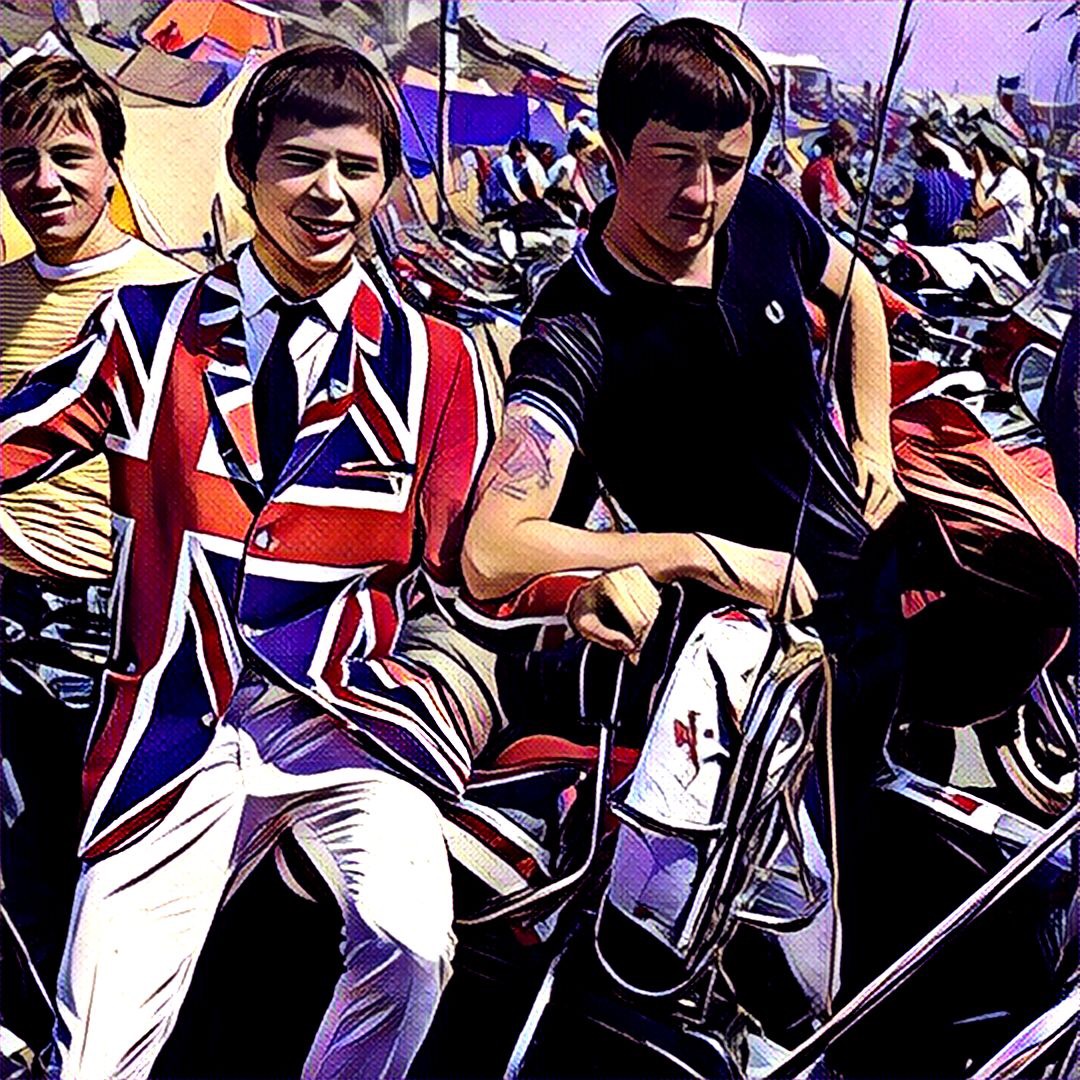
On Dressing British


I just want to make a little note on the subject of dressing British, since that is half the title of this blog.

Dressing British is, historically speaking, dressing Jewish.

Since at least 1850, London's garment trade was largely Jewish. Jews dominated the cap-making trade in London and Manchester. According to this web site, one out of seven male Jewish immigrant worked in garment factories in in London's East end in the early 20th century. Jews also made up a large part of the custom-made tailoring trade, and later moved into the retail garment trade.

So when you see an classic English City Gent, in his Oxford shoes, dark suit, rolled umbrella, and bowler hat, there is a very good chance you are seeing someone wearing clothes tailored and sold by Jewish artisans and merchants. When you see a British mod, in bold colored casual clothes or dapper Italian suits, you're seeing a movement that largely started with Jewish youths who had access to the clothes wholesale, thanks to family connections in the garment trade. When you see British punks, you are seeing a movement that got its start with producer Malcolm McLaren, who owned a music and fashion store in West London, and whose mother was a Jewish woman whose family was in the diamond business, and whose stepfather was in the rag trade.

This may mean more to me than to most people, as I lived in England as a boy and am a bit English myself, biologically speaking. But still, it's always nice to know that no matter how goyish my fashion choices might sometimes be, I'm always secretly dressing Jewish.

Dress British


Firstly, a quick note: I authored an article for Tablet about the first three months of my study of Yiddish. It can be found here.

Now, I wanted to talk a moment to explore the phrase "Dress British Think Yiddish." There is a sort of loose consensus about what it means: Dress mainstream, think outside the mainstream. I think I picked it as the title for my blog because I was born to Irish-American parents and adopted by a Jewish family, and so, even if I didn't already dress in tweeds and flat caps, I still end up looking like someone sculpted a caricature of an Irish guy out of a potato, and so the British/Yiddish thing is especially on the nose in my case.

As far as I can tell, the earliest appearance of the phrase in print was in the Greensboro Daily News on December 24, 1961 from the column "People, Places and Things" by CA Paul. He wrote:

Harry Golden believes it is time for IBM to abandon its motto, "THINK," and suggests a substitute: "Look British, Think Yiddish." 

Harry Golden was a newspaper editor and journalist, and years later, in his "The Golden Book of Jewish Humor" he seems to credit himself with the phrase -- I need to track down the book to get the complete story, but it looks like he wrote it in a column and then, literally a few days later, it was quoted back to him by a Hollywood press agent.

A year later, the Jewish Spectator quoted the phrase as the more familiar "Dress British, Think Yiddish," and said it was new. The same year, Commentary offered up the same phrase, and claimed it was dictated by Madison Avenue. In 1964, Show: The Magazine of the Arts credited the phrase to a sign in New York's garment center.

In 1965, the New Jersey State Bar Journal published my favorite version of the phrase, quoting Victor S. Kilkenny: PRESCRIPTION FOR SUCCESS: Look Irish — Dress British — Think Yiddish. 

I haven't found the original article, but the Jewish Journal of New Brunswick, New Jersey from Friday, October 22, 1965 ran an excited article summarizing the contents of an Esquire story (A Google search leads me to suspect it's from from Volume 64 - Page 115; maybe I'll try to get to the library soon to look it up). "Esquire Finds Yiddishe Kop on Madison Avenue." 

"The article is appropriately titled 'The Yiddishization of American Humor,' written by the humorist, Wallace Markfield," the story tells us, and goes on: "Esquire's author claims (he admits he can't prove it) that the Jewish comic style has invaded Madison Avenue advertising agencies, too. Such slogans as 'Fresher than this there isn't" (for a well-known cream cheese) and "With soap it's loaded" have a definite Yiddish ring to them. And certainly, who could deny that 'Dress British -- Think Yiddish' resembles 'Think British -- Think Byford.'"

Kildare Dobbs, editor of the Canadian general interest magazine Saturday Night, returned the phrase to the garment district in a 1968 story about a schmatte merchant named Hymie. "His creed is simple," Dobbs wrote. "Dress British, Think Yiddish."

By 1969, the phrase was popular enough to become a button, which I own an example of. Venture Magazine mentioned the fact in Volume 6 from that year, mentioning that they are sold alongside buttons reading "Jesus was raised in a kosher home," suggesting that the phrase had been adopted by a inchoate Jewish pride movement.

The Big Apple ran a piece on the phrase back in 2009, and they mention two additional possible sources: First, there was the law firm of Finley Kumble, where Mr. Kumble was famous for advising new layers with the phrase (as well as reportedly banning bagels for being "too ethnic.") But the firm was started in 1968, making it too later to claim ownership. The Big Apple also mentions the financial firm of Salomon Brothers, which supposedly had this as the unofficial policy for their stockbrokers, which included future mayor Michael Bloomberg.

They're a pretty old firm, founded in 1910. But the first mention I find of the phrase being bandied about dates it to 1966, in the book "The Prophet of Love: And Other Tales of Power and Deceit" by  Elizabeth Kolbert, and Bloomberg was there the same year, so it is very possible the firm picked up the phrase at the same time as anybody else.

Tentatively, I'm giving credit for it to Golden. I'll see if I can track down his book and will report back. (Note: Tracked down book, and he does indeed take credit for phrase.)